

Most teams run closed-lost analysis expecting to validate the usual answers: price, timing, budget. That’s exactly what we expected, too. When we ran ours at the end of 2025, though, a different response kept surfacing: not ready yet.
On its own, that answer felt like a shrug. Vague. Non-committal. So we dug in and started asking better follow-ups. We also pressure-tested what we were seeing with a group of marketing leaders we trust to tell us when we’re wrong. They were hearing the same thing.
The takeaway was simple but uncomfortable. Most closed-lost buyers understand the value of the product. What they do not understand clearly enough is the cost of waiting. There is a gap between “this looks useful” and “this is worth prioritizing right now,” and that gap exists because buyers don’t know what they are missing by not investing.
And the best way to tell that story? Customer proof.
The Evidence Gap report taught us how critical customer proof is to closing deals
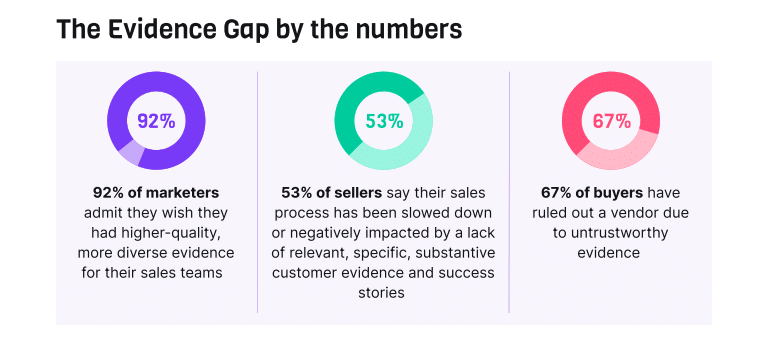
The seller landscape today is tough. Buyers are inundated with choices to the point of decision fatigue. Sure, they look at vendor reports. Or your shiny logo ticker on your homepage. But what The Evidence Gap report revealed as the most powerful conversion tool? Customer proof. And we’ve got the stats to prove it.
Statistic #1: Buyers are over 2× more likely to trust customer voice than company-created marketing claims.
Makes sense if you think about it. There’s a lot of look-alike brands out there all trying to differentiate. As a marketer, I’ve seen my fair share of (and been a part of) “fake it ‘til you make it” marketing.
A lot of buyers have gotten burned by SaaS. They’ve grown weary. They’ve been over promised and under delivered. That’s why industry reports and a feature quote are no longer enough.
Buyers want to hear directly from our customers. They want to know who is using our solution, and what results they’ve had. To the modern day buyer, customer proof is a stronger pitch than the $50K over-polished feature video.
Statistic #2: More than half of B2B sellers say deals slow down or stall because they can’t provide enough credible customer evidence.
Polished videos. Helpful content. Founder influencers. These will get you in the room, but in order to close the deal? You need proof. Proof your product works, and proof it’s the right fit
We’ve had a lot of conversations with our sales team over the past year, and the same themes keep popping up. Buyers want concrete examples of:
- Customers you have in their same industry (e.g. “We work with Slack”)
- An understanding of why they chose you (e.g. “Our Seismic integration”)
- Small and big wins they’ve had (e.g. “They increased closed won rate by 10%”)
Customer proof doesn’t have to be some giant case study. But it needs to be highly specific, easily accessible, and compelling.
Statistic #3: Buyers prioritize real outcomes and metrics over surface-level proof
This hits on my last point above. Those beautiful, built-out case studies are great to have — but they’re also hard to get.
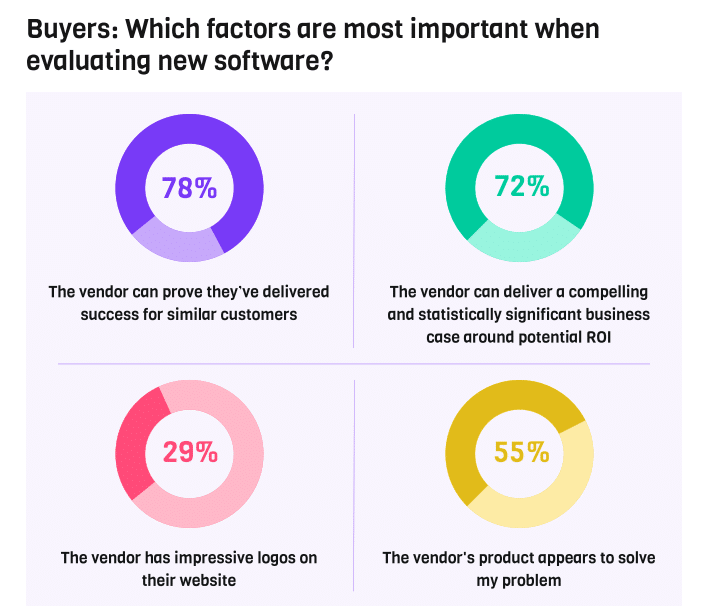
The reality is, buyers care far less about polished assets than they do about proof that feels real and relevant to them. In fact, the vast majority of buyers prioritize evidence that shows you’ve delivered measurable success for companies like theirs and can back it up with credible ROI — while fewer than a third put much weight on impressive logos at all.
That’s why highly relevant, bite-sized customer evidence can be even more effective than traditional case studies, especially when it comes to sealing the deal.
When Sales is in the middle of a negotiation, they’re not sharing a case study. They’re sharing in-the-moment proof points — things like, “We’re seeing healthcare customers cut sales cycles by 30%,” or “This replaced three tools and paid for itself in one quarter.”
That’s the proof that closes deals. And it’s something you can’t afford to wait on as we move into 2026.
What scaling customer proof is doing for marketing leaders in 2026
Marketing leaders don’t debate whether proof matters, but they do deal with the consequences when it’s missing.
Sure, not having customer proof won’t kill brand perception. But it does kill execution. Pipeline influence weakens. Sales confidence takes a hit. Content stops closing the gap between interest and decision. Customers find themselves discouraged and disillusioned when they aren’t seeing the huge ROI numbers they were promised in the sales cycle.
We were feeling a bit of this when the closed-lost survey I mentioned earlier confirmed our suspicions that we weren’t giving the right proof to keep things moving with urgency.
Good news: we’re not the only marketing team who has come up against these challenges. Better news: these teams have also found scaling customer proof to be the perfect anecdote.
Superhuman’s proof drives their whole GTM motion
At Superhuman (formerly known as Grammarly), customer proof isn’t treated as a one-off tactic. It’s treated as a system that has to flex with the business. As Irena Kin, Product Marketing Business Strategy Director, explains:
“Customer story as a phrase is malleable. What makes a story successful shifts based on who’s using it and what they need it for.”
When proof can’t adapt, it stops working. It gets stuck in one format, for one team, at one moment in time. That’s when urgency disappears and deals stall.
Trying to scale proof without infrastructure only makes the problem worse. Ren was super direct about the failure mode (in one of my favorite interview clips of all time):
“If you have Qualtrics and SurveyMonkey and think you can do this yourself, you cannot. Do not try to DIY this! You will fail!”
What fails isn’t just efficiency. Credibility fails. Coverage fails. And the ability to show consistent, defensible outcomes across the funnel fails.
HackerOne’s proof drives late stage conversations
At HackerOne, the impact of missing proof shows up across every GTM motion.
According to Elizabeth Raffa, Senior Manager of Regional and Customer Marketing:
“Customer marketing goes where the business need is. We’re utility players.”
That utility breaks down when proof isn’t accessible or trusted. Instead of reinforcing decisions, teams spend time recreating evidence. Or even worse? Leaning into opinion.
Sales feels this immediately. Cara Peterson, Customer Advocacy Program Manager, summed it up really well:
“Sometimes reps don’t know where to find the right story. My goal is to create a true, central source of truth where all of our customer proof points live.”
Without that source of truth, proof doesn’t show up when it matters most: late-stage conversations, internal reviews, and justification moments. That’s when “not ready yet” enters the pipeline.
Trellix’s proof drives better customer experiences
The demand for customer proof never slows down. As Cache Walker, Director of Customer Marketing at Trellix, told us:
“I don’t remember a time in my career where people ever said, ‘We have enough references.’”
We’re not chasing volume for its own sake. We’re responding to pressure. Sales, leadership, and even buyers demand proof of real outcomes.
Something that makes that proof easier to obtain? Data.
“When you have the data, it’s so much easier to get that customer on record… they’re automatically more engaged and more plugged in,” Cache explains.
That engagement compounds. More proof leads to more participation, better coverage, and stronger GTM alignment.
That transformation is the difference between customer proof as a checked box and customer proof as a growth engine.
Without it, we’re left defending impact we can’t clearly show. With it, we help influence a “not ready yet” into a “closed won” deal.
Big difference.
How UserEvidence customers scale customer proof for closed won deals
Yadin Porter de Leon, Director of Customer Marketing and Thought Leadership at Heroku, wanted a way to talk to customers who were willing to share insights.
Finding those “hand raisers” to give real stories, feedback, and opinions at scale is hard to do without the right tool. So he turned to UserEvidence for help.
“A huge use case (for UserEvidence) was just being able to at scale, for very specific audiences, very quickly and easily find out who are the hand raisers there?” Yadin explains. “And then all sorts of other activity blew up from there.”
That activity? Opportunities to get customers engaged in different ways from events, to customer advocacy programs, and more. Yardin leveraged the UserEvidence platform to turn customers who were hand raisers into brand advocates he could tap into for customer proof.
Using customer proof for customer retention
Customer proof isn’t only meant to influence deals. Great customer evidence also improves retention and lifetime value. Phyllis Fang, Head of Marketing at Transcend, sees customer evidence as the core of Transcend’s product experience.
Their team puts together a “delight” campaign for customers similar to Spotify’s end-of-year “Wrapped” campaign.
“UserEvidence has been a great compliment to making that campaign come together 360…we’ve found some great stats and data points that we otherwise would not have uncovered.”
Fang’s team also leveraged the UserEvidence platform to help build an anchor research report for Transcend:
“Being able to know that we could partner with (UserEvidence) on how the report questions are structured, how research candidates are sourced, how they’re interviewed, how they’re followed up on—all of that we knew we were in great hands.”
Creating a new category and shifting a POV is hard. Being able to leverage customers to develop a unique POV that is backed by customer evidence helps position you as true thought leaders in your space.
You don’t know what you don’t know…until you know
Most GTM teams don’t realize they have a customer proof problem until deals start to stall. On paper, everything looks fine. Pipeline is healthy. Activity is up. Then late-stage conversations slow down and no one can quite explain why.
In our experience, it usually comes down to where your proof lives. If customer evidence only exists on your website or in a handful of polished case studies, it is not showing up when it actually matters. The proof that closes deals is specific, current, and easy to access in the moment a buyer needs reassurance.
Because when decisions are being made, buyers are not looking for positioning or promises. They are looking for confirmation from people like them that this is the right call.
If you want more closed-won conversations in 2026, start by treating customer proof like infrastructure, not content. That shift is exactly what UserEvidence is built to support. Click around our Demo Ranch to see our customer evidence engine in action, or learn more about the new UserEvidence for Advocacy and References.
FAQs: Turning “Not Ready Yet” into “Closed Won” with Customer Proof
What breaks without customer proof?
Without customer proof, urgency breaks—and so does trust. Buyers may see your value but won’t act without credible, relatable evidence that proves it’s worth prioritizing now. And if the only proof you offer is inflated or overly polished, trust erodes even further. That’s when disillusionment sets in post-sale, as customers realize the promised outcomes don’t match their experience. Without authentic, accessible proof, you risk stalling deals and undermining long-term credibility.
What causes B2B deals to stall late in the sales cycle?
Many deals stall not because buyers don’t see value, but because they don’t feel urgency. The biggest gap is often a lack of specific, credible customer proof that shows what’s at risk by waiting—and what’s possible by acting now.
How does customer proof impact buyer confidence?
Customer stories tied to real metrics significantly increase buyer confidence. When prospects hear how similar companies achieved results—like shortening sales cycles or consolidating tools—they’re more likely to move forward with conviction.
Why isn’t traditional content enough to close deals anymore?
Buyers are skeptical of polished marketing and founder-driven content alone. They trust peers more than brand claims, which is why customer voice—especially specific, timely, and relatable—is more effective at converting interest into action.
What makes customer proof effective in late-stage sales conversations?
The most impactful customer proof is specific, relevant, and immediately accessible. Sales teams need quick-hit proof points—like industry use cases and performance outcomes—not just polished case studies, to push deals across the finish line.
How can marketing leaders scale customer proof across the GTM team?
Scalable customer proof requires infrastructure. Tools like UserEvidence help teams capture, organize, and deploy credible stories across channels—transforming proof from a content asset into a core part of your GTM motion.
Can customer proof improve retention and customer engagement too?
Yes. Customer proof isn’t just for net new logos—it strengthens existing relationships. By turning customers into advocates and showcasing their wins, teams can boost retention, drive advocacy, and position themselves as thought leaders.
What’s the risk of not investing in customer proof?
Without customer proof, teams rely on assumptions, opinions, or outdated content to convince buyers. That erodes credibility, slows pipeline, and leaves GTM teams unable to justify value when it matters most—costing deals and momentum.