


Ask any of our sales reps at UserEvidence, the slide from our discovery call deck that undoubtedly gets the biggest “I’ve-been-there” head-nod from customer markers is this one:

It’s almost an inside joke for most of the CMA folks we talk to. How annoying is sales, right? You’re constantly buried in requests from them, they don’t know how to look for anything themselves, and everything they need is URGENT.
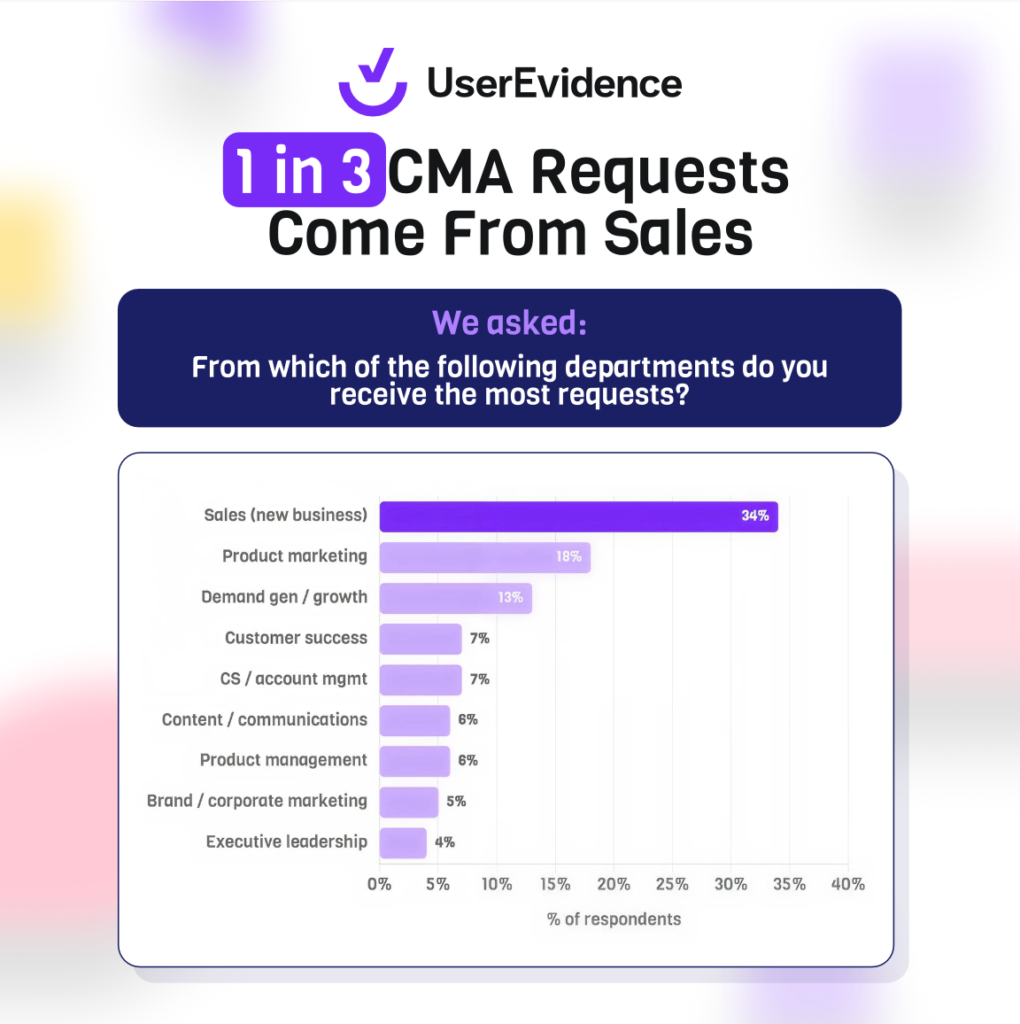
So it was no surprise as we were culling through the results of our 2026 CMA Salary and Career Benchmark survey that when we asked the 126 customer marketers which department they get the most inbound requests from, sales was at the top of the list, accounting for 34% of the asks.
But then as we dug into the next question in the survey (Which department do you collaborate most closely with on a daily basis?), a lightbulb moment was forming:
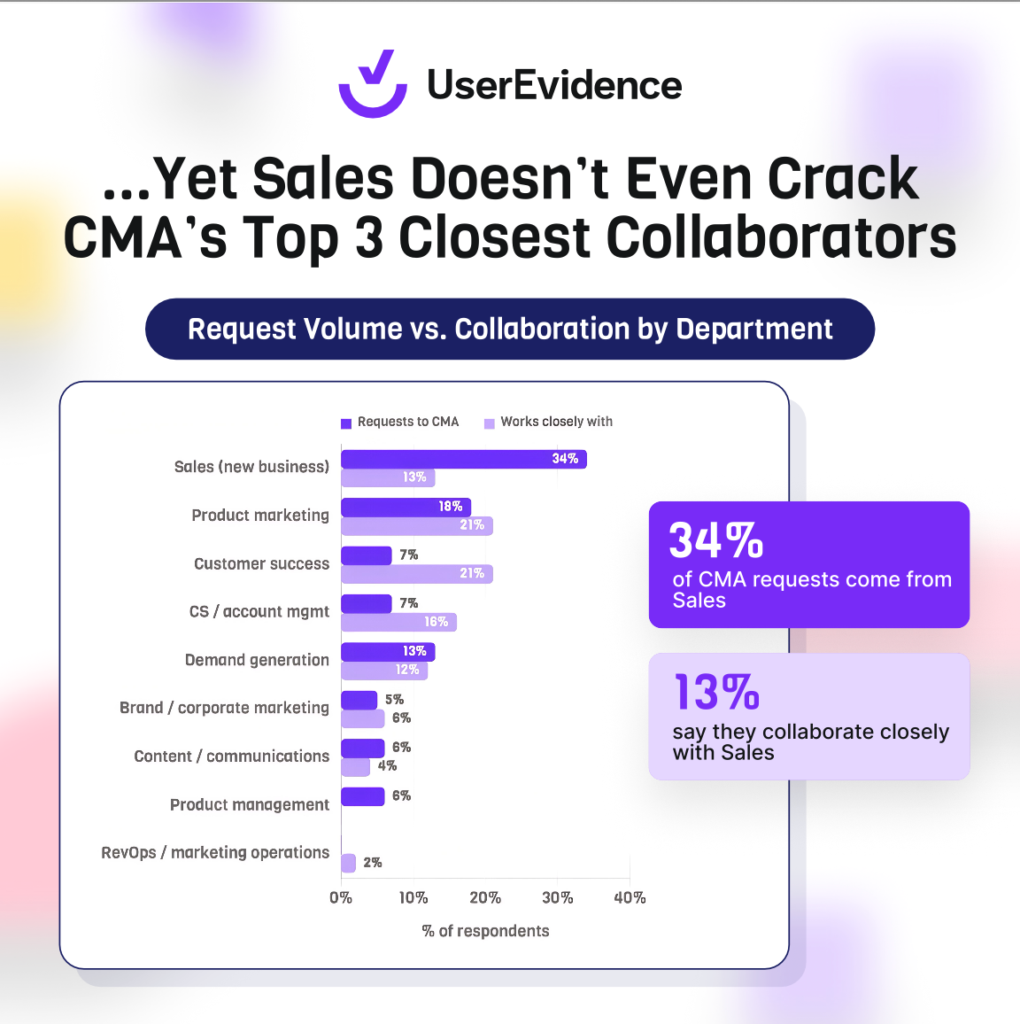
Sales wasn’t at the top of the collaborators list. In fact, it didn’t even crack the top 3.
Only 13% of customer marketers said that they worked most closely with their Sales team.
No wonder CMA feels like a never-ending Sales request center.
It’s because our entire relationship with Sales is reactive.
So… is it impossible to become proactive collaborators with Sales if we’re constantly feeling like a request center?
That’s what we set out to explore. And we knew just the people to chat with to do so.
Tyler Ray is an account executive at LeanData who’s built an AI-powered workflow that lets him self-serve customer proof without ever pinging his CMA team (more on that here). And Madeleine Hurlbut (Mads to us) is an account executive at UserEvidence who works with customer marketers at dozens of B2B organizations every quarter.
Between the two of them, we got a pretty clear picture of where the breakdown happens, and what it takes to fix it.
They’re not trying to be annoying
Here’s the thing about the annoying sibling metaphor: It resonates because the pain is real. But when we actually talked to the sales side, the picture was more nuanced than “sales is needy and lazy.”
When I brought this dynamic up with Mads, her reaction was immediate. The most common theme she sees talking to CMA professionals is that they’re over-indexed on execution and operating in reactive mode, not because they want to, but because they’re put in scenarios where they have to deliver on tight timelines. Sales wants things yesterday.
“A lot of the tension comes out of people wanting customer stories really quickly but not really having a path or an avenue to self-serve,” she told us. “They approach the CMA group as ‘Hey, I’m in a deal and I need something. What can you spin up in the next hour?'”
The key phrase on this one is not having a path to self-serve. It’s not that sales doesn’t want to find things on their own. It’s that the systems aren’t set up for them to do it.
Tyler confirmed this from the other side. Before he had his tools connected, finding relevant customer proof meant searching through dozens of case studies and hoping something matched. When nothing did, he’d go to customer marketing. Not to collaborate, but to ask if they had a better idea of what he could be doing differently. The relationship was functional. It just wasn’t strategic.
And the write-ins from our survey reflect the CMA side of that same frustration. One respondent described their reality this way:
"We are usually at the beck and call of other teams — sales needs a reference NOW, a CSM has a customer ready to advocate NOW, product has a customer comm that needs to go out NOW. I rarely have time to deep dive into customer data or work on customer lifecycle campaigns because there are usually a lot of fires to put out for other people."
Another put it more bluntly:
"My impact is a fraction of what it could be because the sales/revenue org isn't incentivized or goaled against their contribution to CMA pipeline, so telling branded stories is very challenging."
Only 3% of respondents say GTM partnership is the primary focus of their role. Three percent. The function that creates proof for go-to-market teams barely has the mandate to partner with them.
Soooo… both sides are stuck. Sales keeps asking because they don’t have another option. CMA keeps fulfilling because that’s what the role has become. Nobody’s the villain here. We’re all just operating in old systems that don’t work in today’s age of trust.
The proof gap nobody’s measuring
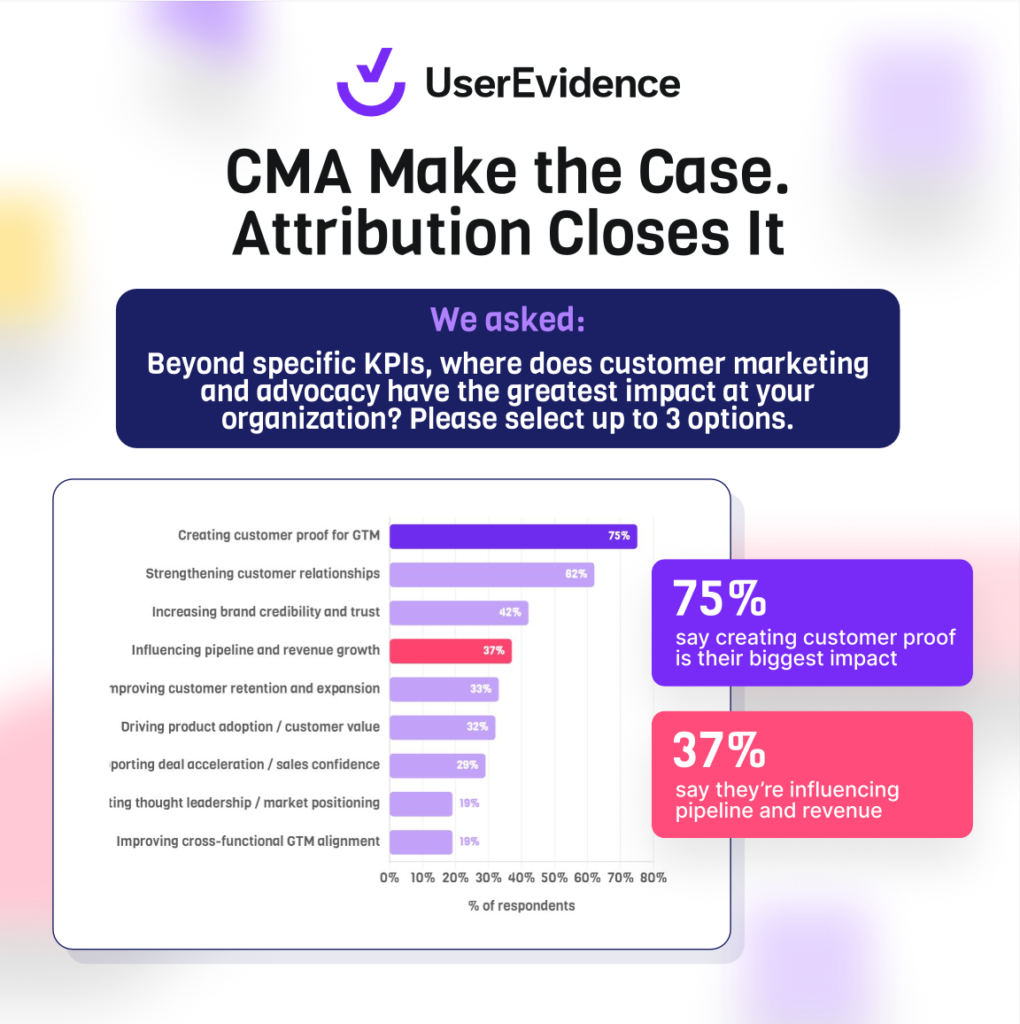
There’s a downstream effect to this reactive loop that the data makes painfully clear. You all know that CMA efforts create value. Seventy-five percent of our respondents say their biggest impact is creating customer proof for GTM teams. But only 37% say they’re influencing pipeline and revenue growth.
That’s a 38-point gap between what CMA produces and what CMA can take credit for.
And the measurement picture doesn’t help. The top metric tracked by customer marketers is assets produced. 61% measure that. Pipeline influence? Only 39%. Expansion or revenue influence? Just 26%.
When I asked Mads about this, she didn’t sugarcoat it. She said it can be really frustrating because CMAs are constantly tasked with doing eight different things for eight different teams, and the layer of program management and reporting has to be a part of that even though it takes structure to work it in.
Her advice was pointed: the most strategic CMAs she sees are the ones who look at their stack and ask which stakeholders they’re serving and how every piece of what they deliver ties back to those stakeholders’ goals. Without that, it’s all reactive. Same resources, zero attribution.
One survey respondent captured the tension perfectly:
“I hope to be more closely tied to revenue impact, which can be hard to gauge when we are focused on intrinsic value adds like brand and community.”
Another described what it looks like when measurement does work:
“The win rate of deals is 46% higher when a reference is attached, and I make sure leaders and sales know and understand this power.”
That’s the difference. One customer marketer hopes to prove impact. The other one already has, because they built the tracking to do it. And here’s the part that should matter to sales leadership too: if you can’t measure CMA’s impact on your pipeline, you can’t invest in it. The measurement gap hurts both sides.
What sales actually wants is to stop asking you
Here’s where these conversations took a turn I didn’t expect. Both Tyler and Mads landed on the same conclusion: The path forward isn’t more collaboration meetings or better request forms. It’s making customer proof self-serve so that CMA can stop being a fulfillment center and start being a strategic partner.
Tyler’s setup at LeanData is probably the most concrete example I’ve heard. He has an MCP server connecting Claude to Salesforce, his call recording tool, and UserEvidence. When he needs customer proof for a prospect, he writes a prompt asking Claude to look at the prospect’s pain points, industry, and company size, then pull matching customer stories from the library. In minutes, he has a competitive comparison document with customer evidence woven in, tailored to the exact deal (no CMA request required).
When the evidence library is accessible and the tooling is in place, sales doesn’t need CMA to find a case study. They need CMA for the things only humans can do, like building customer relationships, facilitating introductions, protecting advocates from burnout. The stuff that actually is strategic.
Mads sees this playing out across her accounts, too. She told us the biggest unlock for customers who’ve renewed and are really happy is enablement. If sellers can see customer proof in their workflow, if it’s bubbled up to them proactively, that’s the best case. Relying on sales to drive it is tough because they’re comped differently from a content perspective.
The survey write-ins from CMA folks reinforce this. One respondent described the gap clearly:
"We have tools that help us do this, but human behavior means in practice, resources are still scattered across our tech stack and awareness and enablement is lacking."
So if sales is your annoying sibling, the answer isn’t to keep handing them what they ask for. It’s to set up the pantry so they can make their own snacks.
How to flip the dynamic
The data points to a real problem, but the conversations gave me optimism that the path forward is actually pretty clear. Here’s what it looks like when CMA moves from request center to revenue partner.
1. Make the library self-serve first
Before any strategic conversation can happen, reps need to be able to find customer proof on their own. That means building a library organized by industry, company size, use case, and pain point, and then making it accessible inside the tools sales already uses. Tyler’s MCP setup is one version. A well-organized platform that sellers can search is another. The point is removing CMA from the middle of every request so you can focus on what actually requires your expertise.

"Rather than spending a ton of time trying to find a relevant customer, I can give Claude a three-sentence prompt and it pulls together proof points that directly relate to the exact issues my prospects are facing."

2. Invest early in deals, not just late
Mads was clear that the best use cases she sees involve CMA being pulled into deals very early — building stakeholder proof points, talking about ROI from the start, creating content in flight rather than scrambling at the finish line. That requires a shift in how both sides think about timing. And it only becomes possible when you’re not buried in last-minute requests.

"More resources allow people to rise above the panic wheel of the content cycle. You need that foundation to even start the collaborative effort at the front end of a deal."

3. Speak to sellers in their language
One of the sharpest things Mads said was about how CMA teams communicate with sales. The more specific you can be, the better. Don’t send the latest blog post and ask reps to share it with every customer. Instead, approach a rep working a specific deal and ask what they need for that scenario. That’s the difference between being a speaker for marketing and being a partner in the deal.

"When sales tunes out, it's because marketing is speaking in really general terms. Get some real-world examples, double down on the stuff that seems like a blinking yellow, and show individual wins."
4. Build the attribution muscle now
You can’t wait for perfect tooling to start tracking impact. Mads’s advice: whether it’s a homegrown approach where you stitch together deal data yourself or a platform that handles revenue attribution, the important thing is putting a system in place. Your human hours are too valuable to spend without getting credit for the work.
"The most strategic CMAs look at their stack and say: what stakeholders am I serving, and how do I tie every piece of what I'm delivering back to their goals?"
Your annoying sibling might be your best ally
What struck me most across both conversations is that nobody on the sales side questions CMA’s value. Tyler knows customer proof helps him win deals. Mads sees it close business every quarter. The survey respondents describe themselves as bridges, growth engines, and the backbone of GTM teams.
The gap isn’t in the work. It’s in the systems, the measurement, and the mandate.
One respondent wrote something that I think captures where this is headed: “Customer Marketing and Advocacy has evolved from a reactive content support function into a foundational, measurable enterprise growth engine: influencing pipeline, accelerating ARR, shaping market perception, and strengthening retention.”
That’s not where most teams are today. But it’s where the best ones are going. And the fastest way to get there might be to stop treating sales like the annoying sibling and start treating them like a partner who just needs better tools. (And a reason to stop pinging you on Slack five minutes.)
The CMA Salary + Career Benchmark survey was conducted by UserEvidence to establish standardized data on compensation, career paths, and professional development across customer marketing and advocacy roles. You can find the full report and methodology here.