


When we were combing through the results of our CMA Salary + Career Benchmark survey, there was one finding that felt like it had a neon, flashing sign pointing to it. This! This is important. We coined it: the advancement gap.
The gist of the gap is this: The amount of CMA folks who want to advance are many. 78% of the 120+ respondents of our survey said they wanted to advance in their career level in the next 1-2 years.
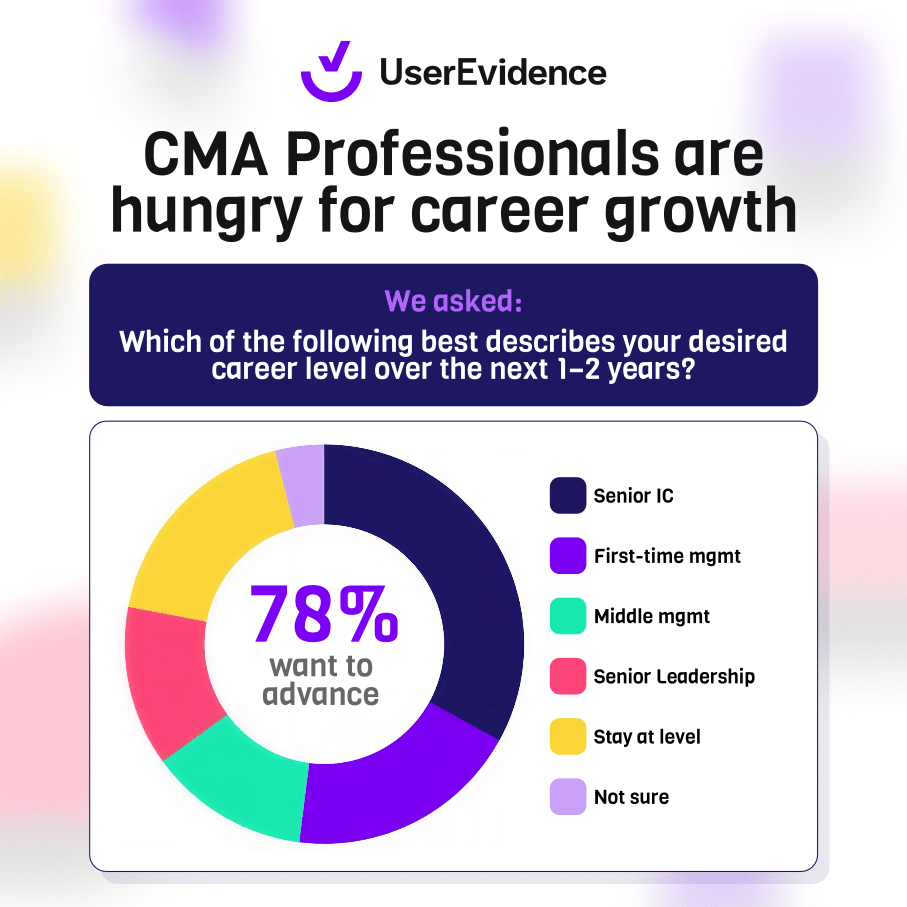
The paths? Nearly non-existent at many orgs. When we asked those who wanted to advance if they had a clear path to promotion, the gap revealed itself: fewer than 1 in 8 actually had a real path to that desired advancement.
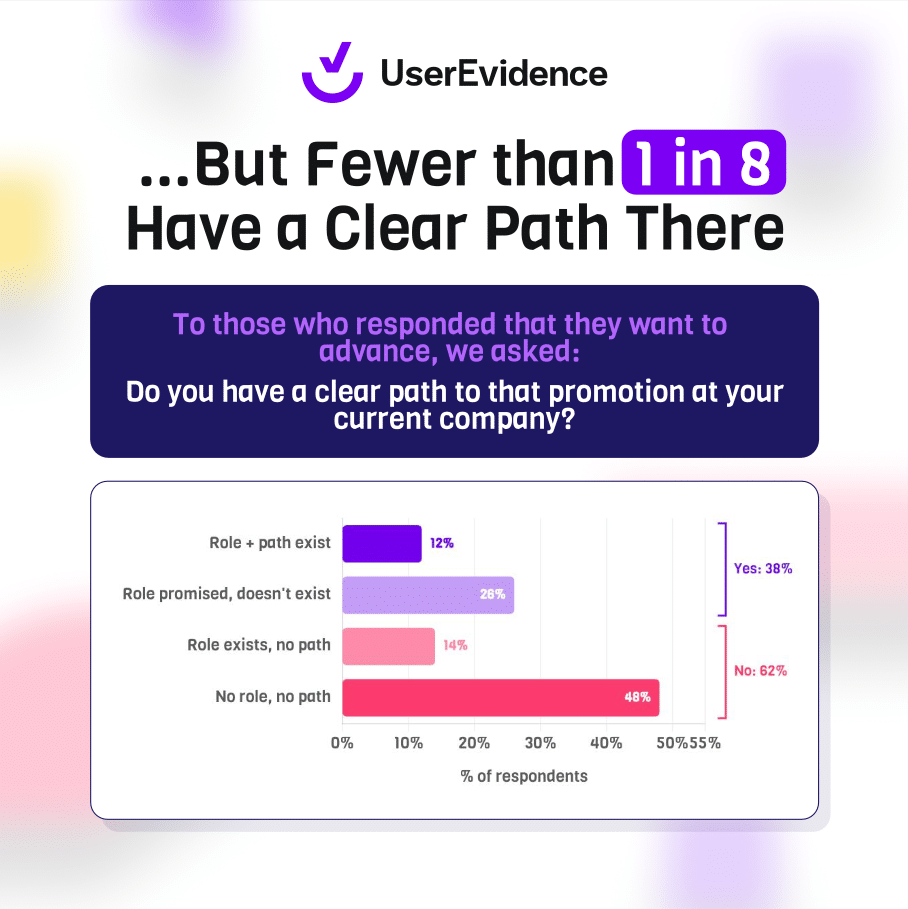
For those of you who need a little assist on the math: 78% of the over 120 respondents said they want to advance in the next one to two years.
Only 12% have a clear path to an existing role.
That’s a 66-point gap between ambition and infrastructure.
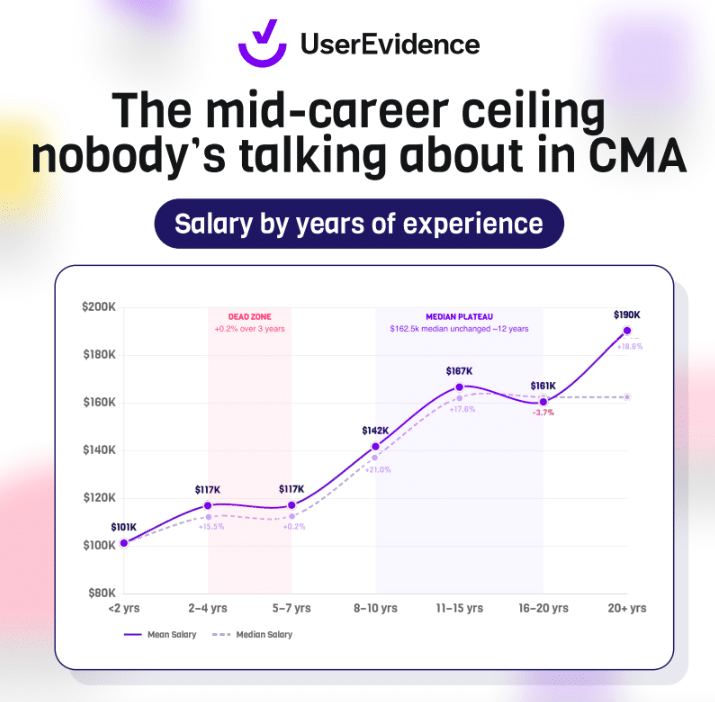
The data is exciting at the surface level. An “a-ha” moment for the role, no doubt. No wonder why it feels so hard to advance. And, it’s one of the many factors that could be supporting the other huge finding from our research: there’s a big mid-career salary plateau for CMA pros that other B2B marketers just don’t see.
But is that all it is? Is this just an “a-ha” moment with no clear path forward?
We sat down with Anna Kim, Director of Community & Customer Marketing at BlueCat, to help us make sense of what we were seeing in the data. What started as a conversation about career paths turned into something bigger: a diagnosis of why the function is stuck in a cycle of rising expectations and shrinking investment. And honestly, it reframed how I think about the whole problem.
CMA is becoming more strategic, but nobody agrees on what it actually is

"There's a lot of confusion around exactly what customer marketing does. If you ask 10 different CMOs, you'd get 10 different answers."

According to all of our research, the customer marketing and advocacy function is on the rise. 69% of respondents say CMA is being seen as more strategic at their organization, and 81% want to stay in the field long-term. Belief in the work is strong.
But when we brought this up with Anna, she immediately zeroed in on the tension underneath those numbers. The function is gaining recognition without gaining definition.
“I think one of the real challenges has been… there’s a lot of kind of confusion around exactly what customer marketing does,” she told us. “And I feel like if you ask 10 different CMOs, you’d get 10 different answers.”
She compared it to sales, where the scope of an account executive role is largely consistent from company to company. CMA doesn’t have that. “With customer marketing and everything that falls underneath it, it’s really different depending on which company you’re talking to, the size of the company, what their focus is.”
The anonymous survey write-ins echo this almost word for word. Practitioners see the impact, they just can’t get the org to see it the same way.
"Customer marketing is an interesting field, because it means different things to different people. Many people think of Customer Marketing as a function that produces case studies and G2 reviews — while that is true, the reality of the role is much more cross-functional and loosely-defined."
"Most of my co-workers don't know what customer marketing is, or that I'm distinctly a customer marketer; they mostly view me as an extension of the corporate & field marketing teams."
This is the paradox at the center of the advancement gap. The work is increasingly valued. The role itself is still too loosely defined for that value to translate into career infrastructure.
The career path problem is structural, not personal
Only 12% of CMA professionals have a clear path to an existing role at their organization. 26% are relying on a role that’s been promised but doesn’t exist yet. And 48% say the role they’d advance into simply doesn’t exist, and nobody’s promised it will.
When I walked Anna through these numbers, she wasn’t surprised. She framed it as partly structural, partly a collective action gap, and her explanation stuck with me.
“I feel like it’s not really happening, at least at a large scale… We’re all just trying to defend the work that we’re doing. We don’t have time or the ability to kind of go out and make this a more widely understood concept in the industry.”
Everyone’s heads-down, proving value internally, without a collective voice pulling the discipline together externally. And when I asked whether CMA will develop a clearly defined career ladder the way product marketing did, she was honest about the timeline.
“Near future… I think it’ll probably stay similar to where it is. I’m hopeful about companies like UserEvidence and the Customer Marketing Alliance kind of starting to do more to pull us all together. But until we really have a collective voice, it’s probably going to be a while still, in my opinion.”
The write-ins reinforce that this isn’t an edge case. One respondent described CMA as “currently fragmented across lifecycle, advocacy, community, events, and customer experience,” and said they’d restructure it as a clear revenue-driving function “so programs are prioritized and resourced based on their impact on growth.” Another noted that “customer marketing exists under multiple marketing leaders, so different customer marketing functions are on different marketing sub-departments, [which] creates silos.”
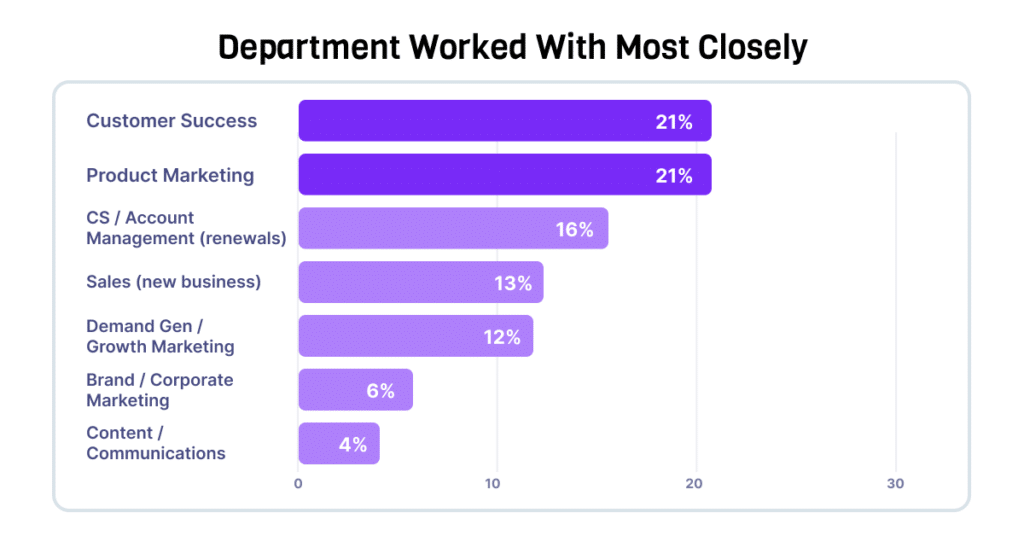
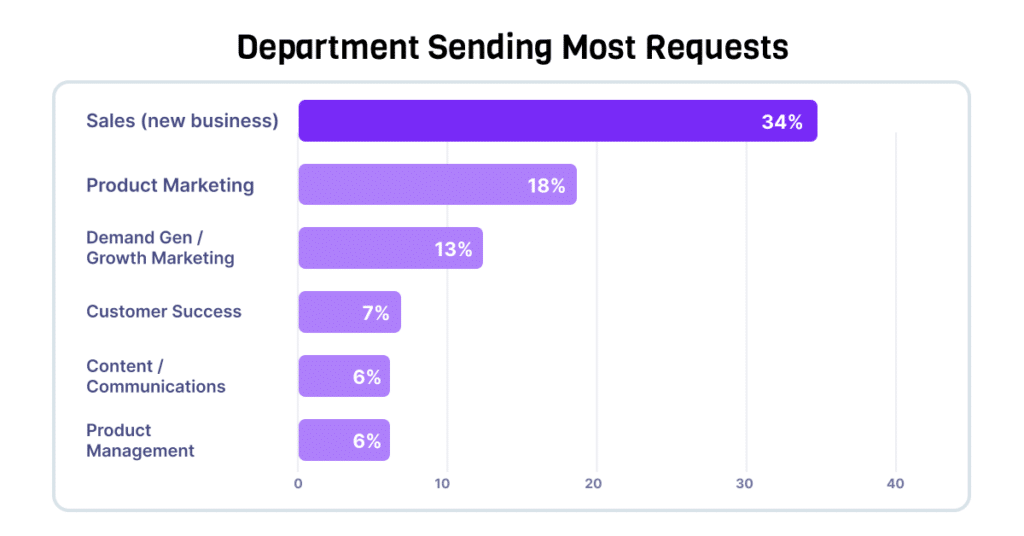
Different pieces of CMA scattered across different teams. And that’s not just anecdotal. According to our research, only 21% of CMA pros report to dedicated CMA leadership. 79% are embedded inside other functions, spread across marketing, brand, product, CS, and CX.
Combine that with the fact that there’s no consistent drumbeat in which departments CMA work most closely with across different organizations, and it’s a recipe for disaster. It’s nearly impossible for a function to prove impact when the impact is spread so widely (and inconsistently) across different orgs.
Self-advocacy is the norm — and that’s a problem
46% of respondents say they themselves are the primary champion of CMA at their organization. Only 9% say executive leadership is championing the function.
When I shared these numbers with Anna, she laid out what she sees as three realistic paths for a customer marketer trying to build a career:
“You have to either have a super supportive CMO who gets it, or you have to find a company that already has a pretty mature customer marketing role that the previous person left for you to come in and walk into, or you have to be super ambitious and really good at selling what you’re trying to build so everyone gets it. And I just think that’s a lot of hurdles for most people to get through.”
What struck me is what she said next. Even path one (the supportive CMO) has limits. Anna has that scenario at BlueCat, and she still runs into gaps.
“I am super lucky that my CMO is really, really supportive. He’s just got my back; he really believes that I know what I’m doing. But even he sometimes gets a little confused about what I’m doing and what the value is.”
The write-ins drive this home.
"I wish we had an executive champion. It's hard to feel like our work gets the resources or prioritization or acknowledgment that it merits. This leaves us feeling a lack of clear direction/measurable impact and a lack of empowerment."
Another described their CMO being let go, with no one elevated to oversee marketing, and a “drastic de-prioritization of several CMA efforts that were planned for 2026” as a result.
And another described being hired to revitalize an advocacy program, succeeding, and then watching leadership expectations spiral beyond what was realistic: “The leadership changed three times in 2 years which made it even worse.”
The fragility of top-down support is real, which is exactly why self-advocacy skills aren’t optional. They’re a survival mechanism.
The good news: there is a path forward
It’s not all doom and gloom around here. Our research luckily points to specific, evidence-backed moves that correlate with better outcomes in compensation, strategic recognition, and in career trajectory. And our conversation with Anna brought each of these to life in ways the numbers alone don’t.
1. Tie your work to revenue
CMA professionals measured on expansion and revenue influence KPIs earn a $24,719 salary premium over those who aren’t. 75% of respondents say their biggest impact is creating customer proof for go-to-market, but only 37% say they’re influencing pipeline and revenue growth. Close that gap in measurement, and the comp data speaks for itself.

"One of the key things is tying it to sales. However you can hitch your wagon to that and show that you are influencing sales in a positive way… Everyone says, 'We love making our customers happy,' and that's really important to us. But at the end of the day, a lot of times, sales is what really matters."

2. Build cross-functional champions
CMAs with cross-functional partners as their champions were the most likely to report being viewed as more strategic (80% to be exact). Executive leadership champions actually ranked lower at 64%. The conventional wisdom is “get exec buy-in.” The data says being embedded across the org matters more.

"As you're working with all these people, you can say, 'Oh, we could use the community for that.' 'Oh, we have customer evidence that could help with that.' Kind of inserting yourself in all those really supportive ways is a good way to really build yourself internally."

3. Invest in the skills the field is moving toward
AI and emerging tech literacy jumped from the 11th most critical skill historically to number one going forward. Revenue strategy alignment, executive communication, and data analysis round out the top four. The field is shifting from execution-heavy skills to strategic and commercial ones. Invest accordingly.
4. Build resilience (seriously)
This one doesn’t show up in a cross-tab, but Anna named it as the skill that holds everything else together. In a field where 46% are self-championing and 48% are aiming for a role that doesn’t exist, the ability to keep building when nobody’s handing you a path isn’t optional.

"The ability to not take things personally and to keep persevering if people don't get what you're doing or they don't get the value, like, not to let that deter you. So really being able to come back and rethink things, see how you can better insert yourself into their strategy."
The case for CMA (despite everything)
For anyone in the thick of it right now wondering if the fight is worth it, Anna closed our conversation with something I keep coming back to.
“You get to engage with customers in a way that they get really excited. I find it very energizing to be surrounded by customers and trying to figure out what’s really mutually beneficial… When you see people out in the community wearing jackets or shirts or hats from whatever program they’re a part of, that loyalty that we can generate is just super rewarding.”
“It’s kind of cool to be that person who ties that all together and creates this really mutually beneficial, symbiotic kind of relationship between the companies and the customers.”
And one anonymous respondent captured the full picture in a way I couldn’t say better myself: “We’re a forgotten bunch. I don’t think teams realize how much impact we have on the business — from sales cycles to CS to implementation/product. We’re a part of every department, and the stronger our CMA team is, the better for everyone.”
The advancement gap is real. But so is the conviction of the people working to close it.
The CMA Salary + Career Benchmark survey was conducted by UserEvidence to establish standardized data on compensation, career paths, and professional development across customer marketing and advocacy roles. You can find the full report and methodology here.