
Why AEO demands a new kind of proof
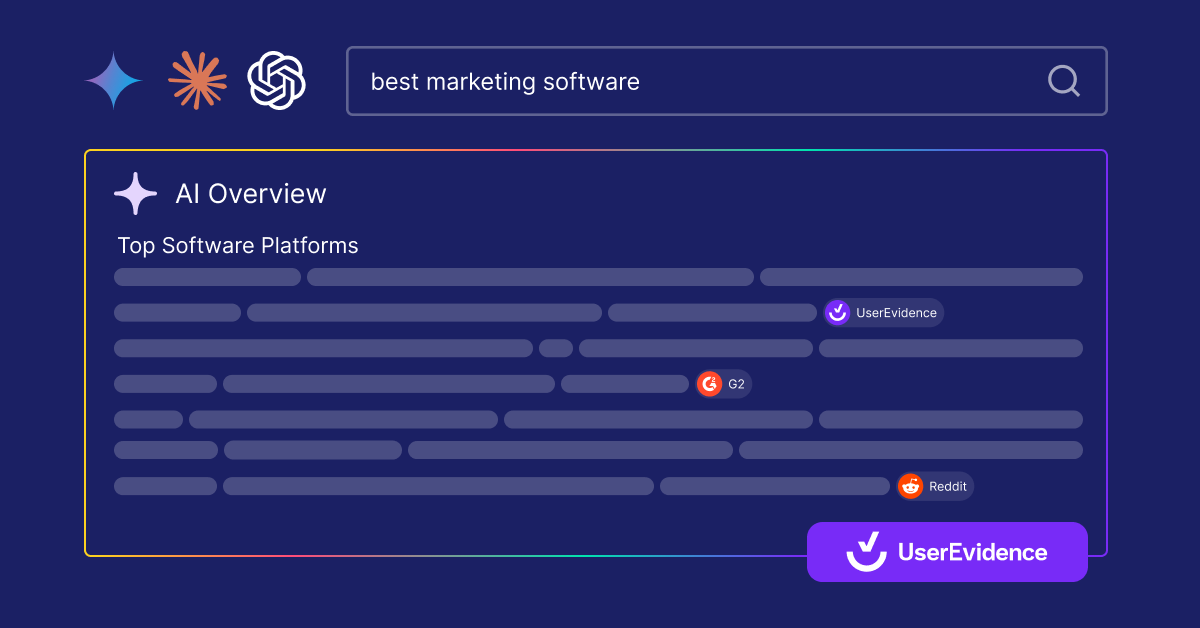
AI-assisted research is changing how buyers discover and evaluate B2B software. Instead of searching and clicking through vendor pages, buyers are asking LLMs “what’s best for me?” and trusting the first cited sources as truth.
The bar has moved from persuasive marketing copy to credible, source-backed information. Educational pages with clear structure, literal phrasing, and verified citations are what gets pulled into generative responses over abstract positioning.
Two risks every marketer now faces:
- Inclusion: If AI engines can’t reliably read and cite your content, you don’t appear in answers at all.
- Accuracy: When you do appear, AI systems summarize you based on what they can find. Without attributable customer evidence, that summary can be vague, generic, or wrong.
AEO isn’t won with marketing copy. It’s won with readable, structured, verifiable proof. And the teams that can systematically publish that proof will pull ahead in AI-assisted buying.
A note before we dive in: No one has fully cracked the AEO code yet, including us. How LLMs select, weigh, and cite sources is still hazy. The mechanics vary by model, and the measurement tooling only emerged in the last year or so.
What we do have is a strong hypothesis, directional signals, and a set of areas worth paying attention to now. That’s what this playbook is: our best thinking on what we can do while the playbook is still being written.
Who owns AEO?
AEO ownership tends to land across a few roles:
| Persona | Their AEO stake | How UserEvidence can help |
|---|---|---|
| Content / SEO owners | Primary AEO program owner. Rebuilding content strategy around LLM question patterns instead of traditional keyword rankings. | Proof insertion into landing pages, research libraries formatted for AI readability, MCP-powered content workflows, ROI studies backed by research methodology |
| Customer Marketing | AEO co-owner. Owns the customer voice and the advocacy surfaces AI systems already trust. | Advocacy missions, verified testimonials and stats, named attribution at scale |
| Marketing Leadership | AEO sponsor. Needs it to be measurable and tied to pipeline. | Repeatable customer evidence and advocacy program foundation |
| Product Marketing | Adjacent but cares about how AI describes your product. Accuracy of AI-generated summaries, competitive narratives. | Verified outcomes to back up product claims, named attribution for competitive messaging |
Starter checklists by persona
What each function in marketing can get started with, inspired by our own experiments.
✅ Content / SEO Owner
- Map the top 10–15 questions LLMs are answering in your category (use tools like Gemini, Perplexity, ChatGPT, and Claude to benchmark what’s currently being said about you)
- Audit your 5 highest-traffic pages for proof density — does each one include a specific, named customer outcome?
- Audit page formatting to include clear H2/H3 question headings with literal, direct phrasing
- Work with Customer Marketing to pull verified and attributable stats + ROI outcomes
- Establish a monthly content refresh cadence to layer in new proof as it becomes available
✅ Customer Marketing
- Work with Content/SEO to map which proof assets match which LLM question patterns — and prioritize filling gaps
- Launch a G2 review campaign to increase the volume of verified, named reviews on a high-trust surface AI already pulls from
- Identify one community platform (Reddit, Slack community, LinkedIn group) where your customers are active, then audit what they’re saying there
- Tag your assets in UserEvidence by feature, industry, use case, and buyer persona so they’re easy to pull for content enrichment
- Set a quarterly cadence for advocacy missions — sustained volume matters more than one-time spikes
✅ Marketing Leadership
- Spot-check 3–5 key LLM queries about your product or category and note whether you appear, what’s said, and whether it’s accurate
- Confirm that AEO measurement is part of a regular marketing reporting rhythm (even if directional for now) and bake into team OKRs
- Align on the framing: AEO is a program, not a campaign. Set a 90-day horizon to evaluate early signals before drawing conclusions
✅ Product Marketing
- Run a quick AI audit: ask Gemini, ChatGPT, Perplexity, and Claude “What does [your product] do?” and “What’s the ROI of [your product]?” — note where answers are vague, missing, or wrong
- Review competitive positioning — are competitors showing up more accurately or specifically in AI answers than you are?
- Partner with Customer Marketing to gather named, verified testimonials, specific ROI stats, and competitive displacement quotes tied to your key product narratives
Common blockers and how to unblock them
| Persona | Common blocker | How to unblock |
|---|---|---|
| Content / SEO | “We have customer proof, but we’re not sure if it’s in a format AI systems can find or cite.” | Look for ways to publish and insert customer proof as real, crawlable on-page text. UserEvidence research libraries are structured specifically for this and built so LLMs can find, parse, and cite the content. |
| Content / SEO | “I don’t know which questions LLMs are actually asking about us.” | Start with a manual audit: run 10–15 searches in Gemini, ChatGPT, Perplexity, and Claude. Note where you appear, where you don’t, and what’s said. That’s your gap map. |
| Customer Marketing | “We don’t have enough named proof… most customers prefer to stay anonymous.” | Collect aggregate stats-based proof where full attribution isn’t possible (e.g., a survey of 25 customers saved $, publish a customer ROI study, etc.). Even partial attribution (role + company) is stronger than none. Prioritize named where you can. |
| Customer Marketing | “We’re still figuring out our advocacy and community programs.” | Focus on a crawl, walk, run approach. Run targeted campaigns in areas that are already proven to be cited by LLMs, such as G2. Keep asks small and specific (“Tell us about a moment [product line] made an impact for your team”). |
| Marketing Leadership | “I can’t tie AEO to pipeline yet, it’s too early.” | Start with LLM referral traffic as a leading indicator. It’s a measurable proxy while the field matures. Set a 90-day baseline now so you have something to compare against later. |
| Product Marketing | “I don’t own the content or advocacy program. I can’t drive this myself.” | You don’t need to own it. Flag the specific AI answer accuracy gaps (ex: competitive, company narrative, feature messaging, etc.) to whoever does own content and customer marketing, with examples. That’s a high-leverage input PMM can provide. |
The 3-Step AEO Playbook with UserEvidence
Here’s the repeatable motion customer marketers and content teams can run today.
Step 1: Curate | Build a bank of verified customer proof
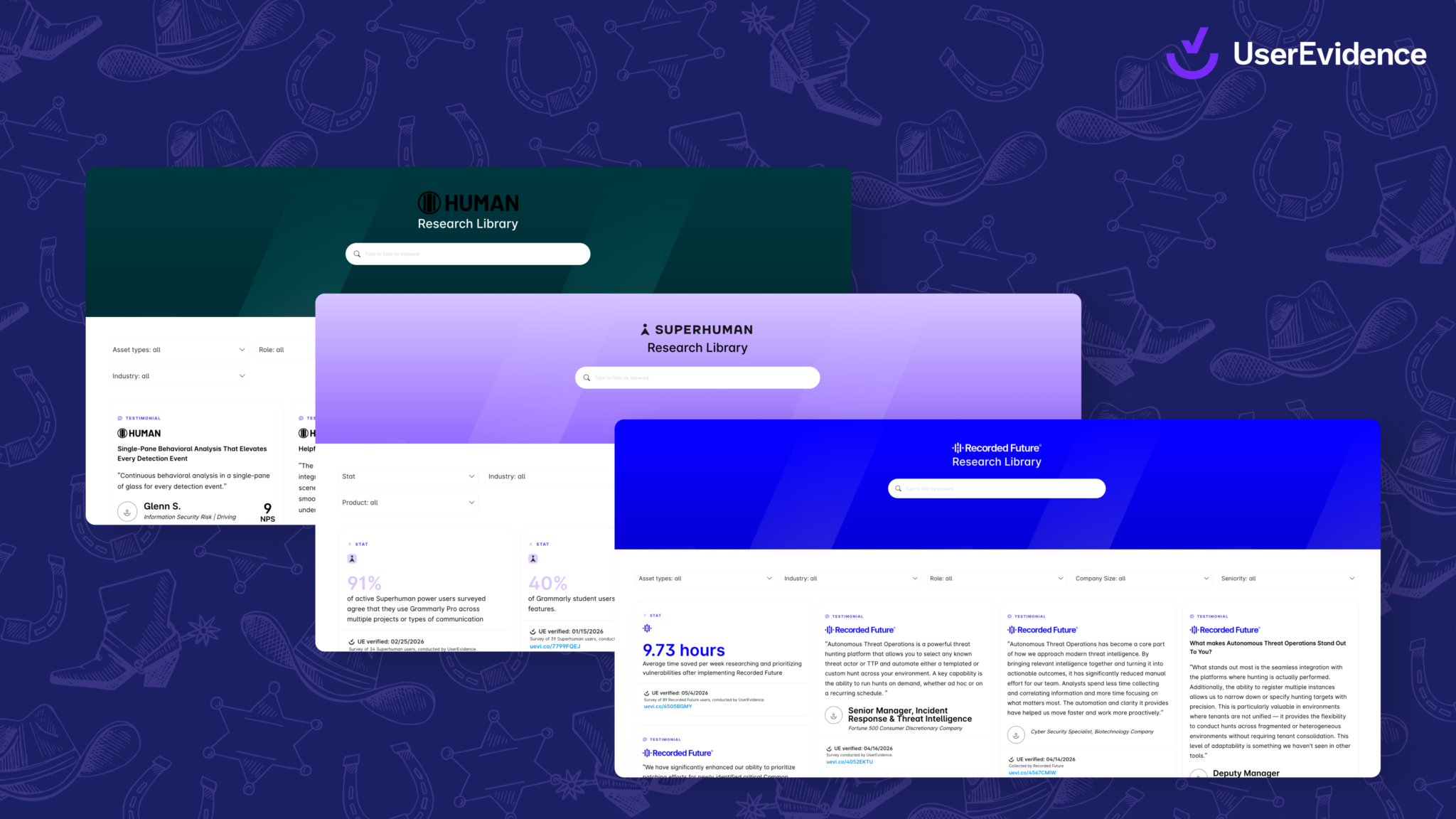
AI systems reward attribution. Anonymous quotes are not worthless, but named proof (speaker, title, company) creates a structural trust signal.
What to do:
- Use UserEvidence to collect verified ROI stats/testimonials at scale and consolidate your existing proof (e.g., case studies, G2 reviews, videos) in one place so they’re organized, tagged, and ready to use
- Third-party verification helps signal credibility to both buyers and AI systems
- Prioritize named attribution (customer name + title + company) wherever feasible
- Use UserEvidence’s built-in approval pages to make it easy for customers to edit and provide their level of attribution
- Tag and group your customer proof using custom classifiers
- Example: by industry, use case, buyer persona, and business outcome (such as ROI, time-to-value, implementation, etc.)
UserEvidence capabilities:
- Research libraries of verified stats and outcomes
- Long-form ROI studies with real customer attribution
- Named testimonials with consent and audit trail built in
Quick takeaway: Pull your best customer proof, wherever it currently lives (case studies, G2 reviews, testimonials, call clips) into one consolidated bank. Prioritize named attribution and tag each piece by industry, use case, and outcome so it’s ready to use.
Step 2: Publish | Make your proof AI-readable
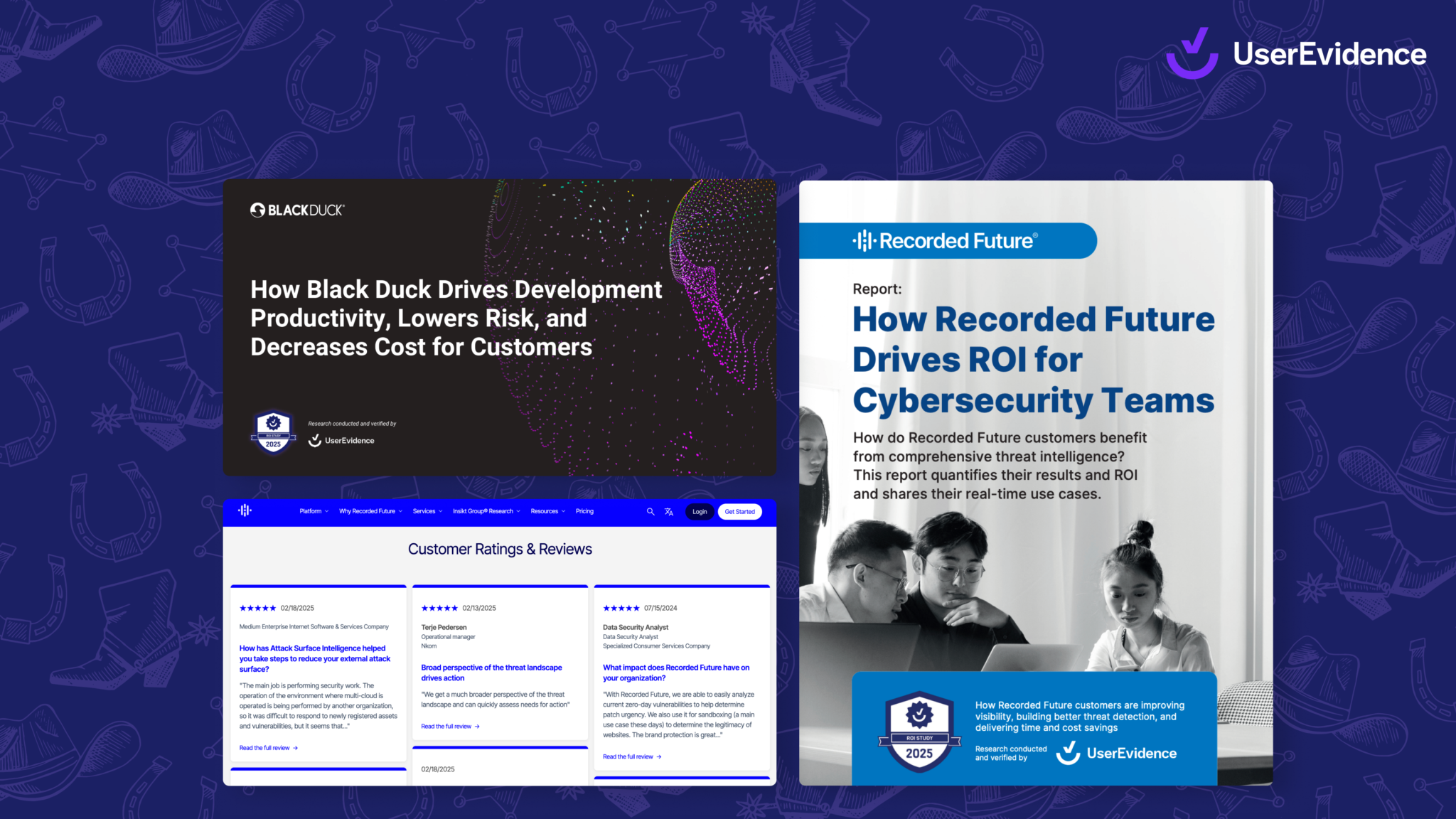
Format and structure play an important role in the way AI systems parse pages. They reward educational, question-led content with clear headings, literal phrasing, and scannable sections.
What to do:
- Structure pages with clear headings, messaging that leans more educational, and specific outcomes with attribution when available
- Embed your verified customer proof library directly into your top pages as crawlable, indexable text
- Example: Use UserEvidence’s website embed to publish your UE proof library on your site. Just embed your library where you want proof to appear (e.g., a “Customer Wall of Love” section or embedded into a “Why Us” page).
- Sprinkle individual proof points (a stat, a named quote) throughout other high-traffic pages like product pages, competitive pages, and industry pages
- Example: Huntress weaves UE-verified stats right under the hero on their Managed ITDR page, then named customer quotes further down tied to specific capabilities. Each proof point is small, sourced, and placed where it’s relevant.
UserEvidence capabilities:
- Research libraries reformatted for LLM readability
- Website embed that loads proof on-page — readable and indexable by AI
- MCP server that lets AI content tools (like AirOps, Profound, etc.) pull approved, verified proof into articles and landing pages automatically
- Governance built in: customer consent capture + audit trail + marketer publish gate before anything goes live
Quick takeaway: Pick your 3–5 highest-traffic pages and audit them for customer proof density. Add at least one verified, named customer outcome to each ideally in a scannable, clearly labeled section near the top.
Step 3: Activate | Drive verified mentions on trusted third-party surfaces
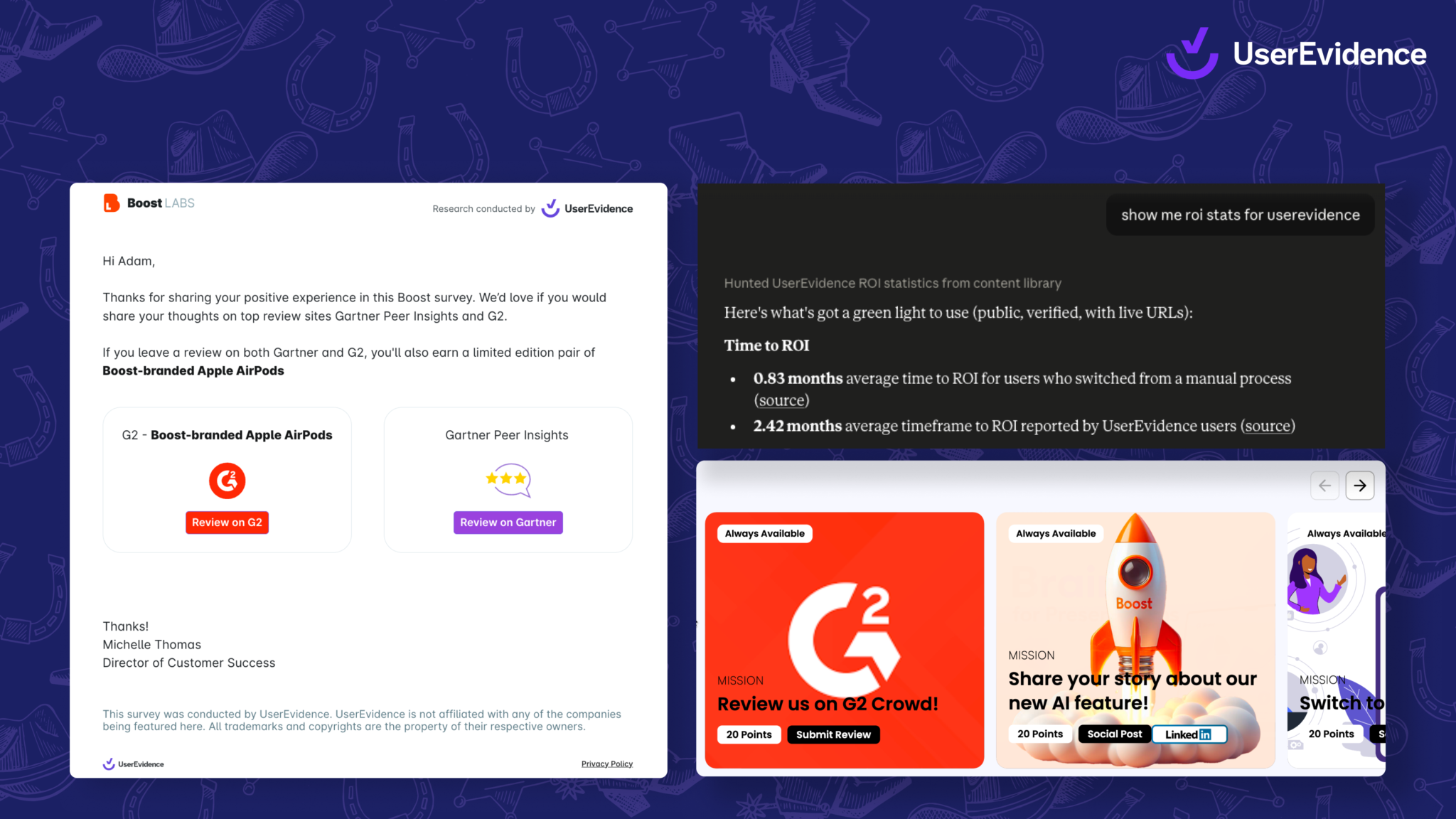
It’s already well-established that AI systems pull from G2, Reddit, third-party review sites, and community discussions. Advocacy is how teams systematically activate customers into those confirmed surfaces.
What to do:
- Run advocacy missions to activate customers into G2, Reddit, and community platforms
- Examples:
- Send a UserEvidence Customer Census Survey and add a page at the end that directs respondents to leave a G2 review
- Create advocacy missions for customers to update their old G2 reviews or participate in Reddit discussions
- Examples:
- Increase the volume of verified, attributable mentions across the web
- Treat third-party surfaces as a parallel publishing channel, not just a nice-to-have (e.g., “where does this fit into existing marketing campaigns we’re already running?”)
UserEvidence capabilities:
- Advocacy missions that drive real customer activity on high-trust surfaces
- Coordination across G2, Reddit, and community platforms answer engines already reference
AEO content formatting cheat sheet
How you structure a page matters as much as what’s on it. Here’s how to format proof-enriched pages for maximum readability.
| Element | ✅ Do more of this | ❌ Less of this |
|---|---|---|
| Page headline | Answer the question directly (“What’s the ROI of [Product]?”) | Abstract positioning (“The Future of Revenue Intelligence”) |
| Headings | Clear, literal H2/H3s that mirror how buyers phrase questions | Clever or branded section names that require context to decode |
| Customer quotes | Named attribution: “Jane Smith, VP Marketing at Acme Corp” | Anonymous or role-only quotes: “A senior marketing leader said…” |
| Stats and outcomes | Specific, sourced, attributable (“43% reduction in time-to-close — Acme Corp ROI Study”) | Vague superlatives (“dramatically faster,” “massive ROI”) |
| Page structure | Short paragraphs, bullets, scannable sections | Long walls of narrative copy |
| Phrasing style | Literal and direct (“UserEvidence integrates with Salesforce”) | Abstract marketing language (“seamless revenue ecosystem synergy”) |
Rule of thumb: If a human reading quickly could mistake a section for marketing fluff, an AI will too. Ground every claim in a specific outcome with a real source.
Our own AEO experiments
We’re running our own AEO program the same way we’d tell you to: building content around the questions LLMs actually ask, then embedding verified customer proof directly into those pages as readable text.
It’s early, and we’re still proving this out ourselves, but we’ve seen an increase in LLM-referral traffic since starting the program.
A few directional findings from external research (treat as signals, not guarantees):
- Statistical enrichment, citation addition, and structured formatting may improve source visibility
- Literal, direct phrasing tends to outperform abstract marketing language
- Named attribution may boost trust signals vs. anonymous quotes
- Third-party stats often cite back to the original source; first-party benchmarks and outcomes can earn brand-specific citations
- Technical visibility matters: ensuring the content on your site is readable by AI crawlers, by checking
- SSR (server-side rendering) → which makes sure your page’s text is visible to bots, not just humans
- Whether AI bots are allowed to access your pages
What we’re working toward measuring:
- Do proof-enriched pages actually get cited more often in LLM responses?
- Does named attribution measurably improve how AI systems describe a brand?
- Can we tie advocacy mission activity to changes in third-party surface visibility in AI answers?
More to come: We’re integrating with AI content and visibility tools (such as AirOps and Profound) to help teams operationalize and measure AEO more systematically. We’ll be sharing what we learn, including results from our own experiments, as the program matures. If you want to be among the first to hear, get in touch.
Ready to build your AEO proof program?
UserEvidence helps marketing teams build a repeatable evidence and advocacy program, one that gives your brand a better shot at showing up in AI-generated answers, backed by proof that’s actually true to what your customers say.
If you’re strategizing ways to make verified customer proof more visible where buyers and AI systems are looking for it, chat with us today.