


This is a past send for The Outpost, a weekly newsletter filled with realtime insights and tactics for building more impactful customer marketing programs. To get The Outpost in your inbox every week, subscribe right here.
Let me be the first to call myself out before we get underway here: I was late to the whole AI thing. Stalwart “just do it yourself” energy coupled with a longstanding “you bastardized my beloved em-dash!” vendetta and an ample dosage of what I once described in a LinkedIn post as “a thoroughly unearned sense of moral superiority” on the matter were the main culprits.
But my (admittedly, naive) mentality flipped on the matter when I saw first-hand how powerful an MCP can be in relieving literally hours of struggle.
Story time: prior to landing my role here, I was actually a customer of UserEvidence. At the time, I shared how UserEvidence’s MCP connector pulled me out of a sticky situation when I discovered members of the marketing team at my company were using AI-generated (AKA fabricated) customer quotes and stats for go-to-market messaging. *shudder* Yeah… no bueno. To make a long story short, I was able to completely reverse the issue, get the whole team working from the same source of truth, and make legal happy in the process. It completely rewired my brain on this. I was singing AI/MCP’s praises from that day forward.
Real quick refresher if you’re newer here or later to the AI game such as myself. UserEvidence has two MCPs: the UserEvidence Advocacy MCP simplifies finding references, building and launching missions to advocates, and pulling program reporting right from a Claude chat with zero tab-switching required. The Evidence MCP does the same thing on the proof side of the equation: surfacing testimonials, case studies, and stats without digging through the platform yourself.
MCPs aren’t magic, but they are connective tissue. I’m not out here building fully autonomous agentic workflows (yet), but with MCPs I am able to quickly and easily link what I already have so Claude can actually do something useful with it (and I don’t have to learn yet another new AI tool).
So, to bring a little reality to the day-in-the-life of an AI-convert-via-MCP customer marketer, I thought I’d share the realities of how I’m using our MCPs in case, along with the real prompts I’m using and what I get back.
On the evidence side:
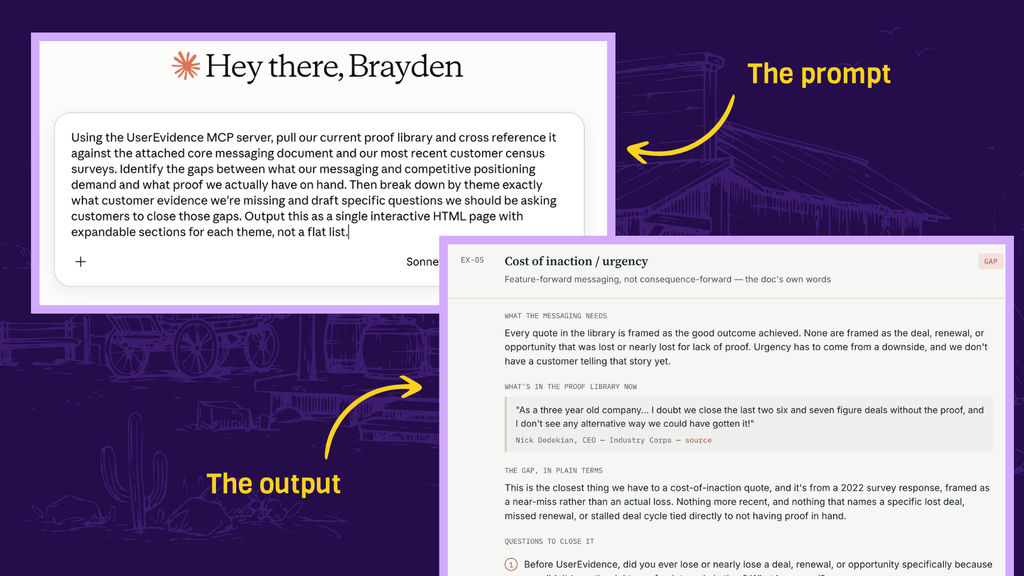
1. Finding the gaps
I check our messaging docs and competitor pages against what customer proof we actually have. Is it strong? Is it recent? With AEO on everyone’s mind, I’m specifically asking what we have from the last six months.
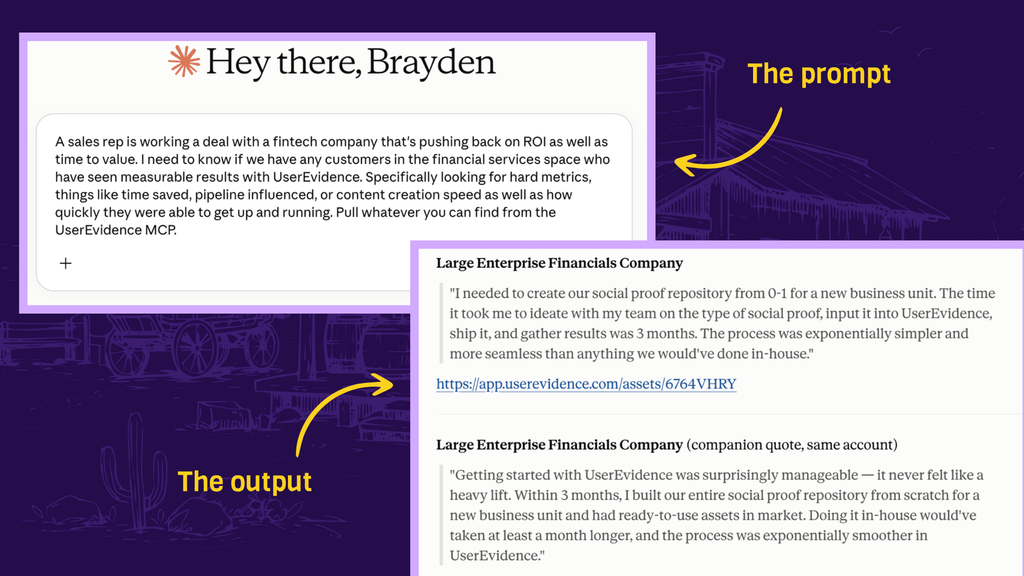
2. Surfacing proof for sales reps
I truly love my sales peeps out there, but they have a lot on their plate, and every CMA reading this knows reps won’t always self-serve. I use the MCP to find what they need insanely faster than what I used to do manually. Anyone who’s tracked their proof in a spreadsheet understands the horror of a “I have a call in 7 minutes with a healthcare customer who primarily services college students studying abroad but is based in LATAM…do we have any other customers that fit that bill?” request. You can’t always fit their needs exactly (see Finding the Gaps above 👆), but getting verified proof in seconds or minutes is beyond powerful! Our sales team at UserEvidence are pros at self-serving using the MCP too (especially our recent integration into Nooks), which has kept me out of the trenches on most of their immediate needs.
3. Building one home for every customer story
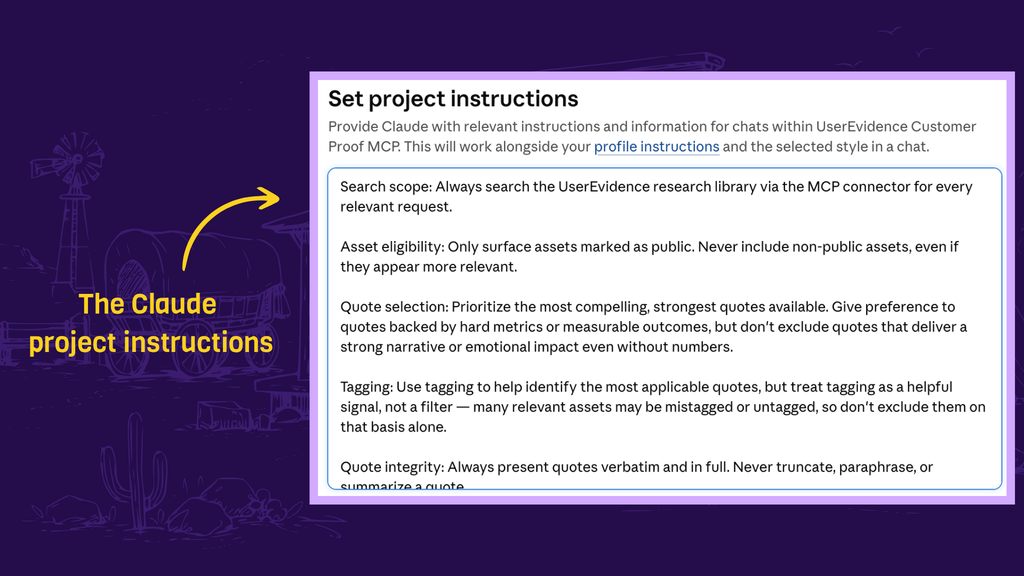
I connected our webinar library, blog content, and UserEvidence data into a single Claude project. I built something similar at my last company and people lost it over how useful it was. Next step: connecting our Gong connector to catch quotes we’re missing entirely.
On the advocacy side:
4. Supercharging our reference request engine
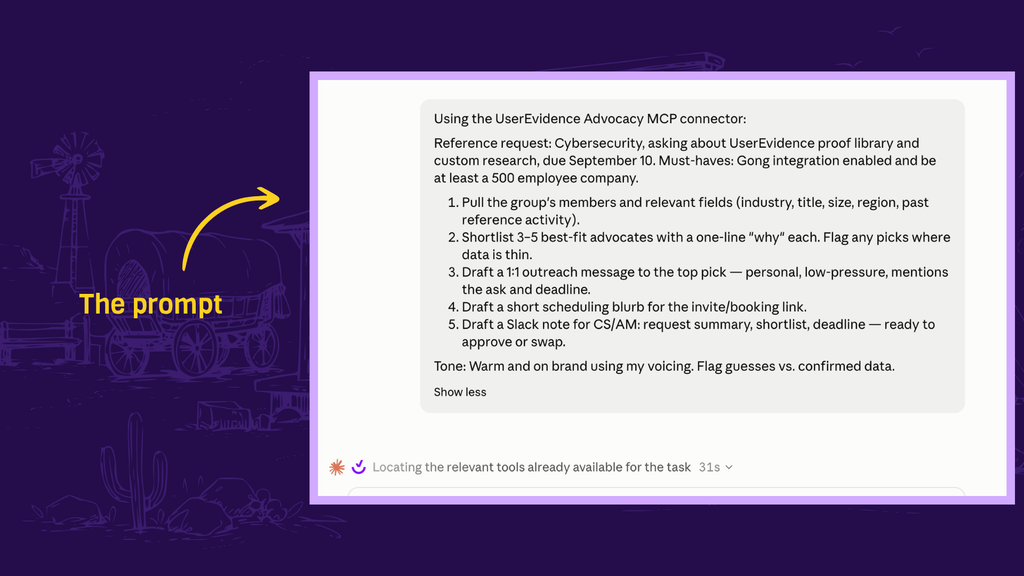
Someone always needs a reference yesterday. Cybersecurity, Gong enabled, 500+ employees, due Friday, go! I used to lose hours to that kind of ask (sometimes days at other companies). Now I can hand Claude the context through the Advocacy MCP connector, point it at the right group, and it pulls the membership, shortlists the best-fit advocates with a one-line reason for each, drafts a real outreach message to the top pick, writes the scheduling blurb, and preps a Slack note so CS or the AE can approve without doing any of the legwork themselves. I still make the final call of course. I just don’t have to be the one who found it.
5. Reactivating advocates who’ve gone quiet
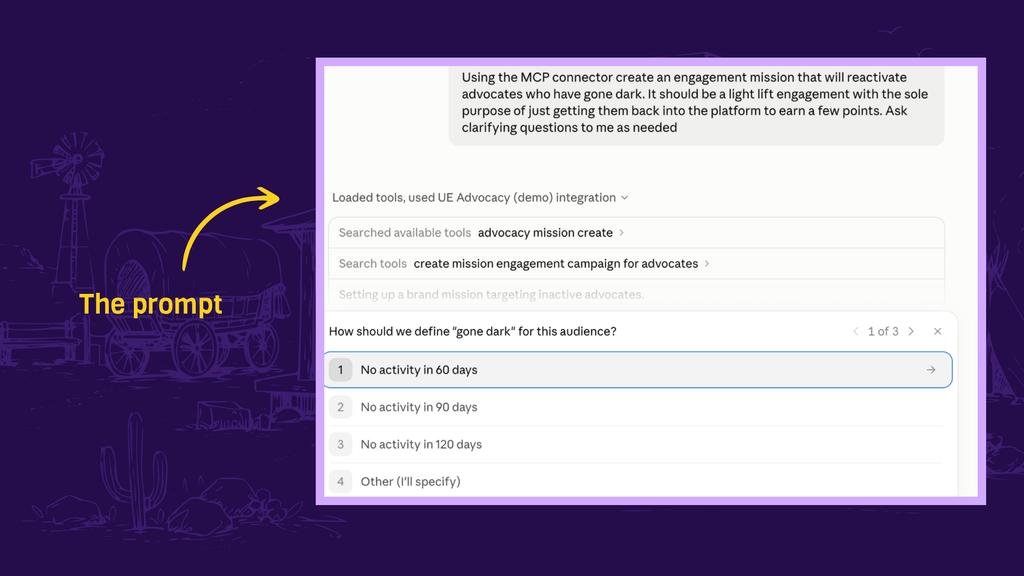
Customers are often most excited to participate when a new advocacy program first launches. But inevitably, the novelty of it all begins to wear off, and advocates can go dark. I was actually on a call last week with a current customer / good friend of mine who was trying to solve this issue. He wanted to reengage his advocates who hadn’t yet done their G2 review mission. The MCP connector with Claude can immediately find those who haven’t done a challenge in X days, segment them, and draft a light reactivation message or mission. It’s easy to whip up something simple, help them earn a few points, and they’re warmed back up.
To be 100% candid, I’m still not where I want to be on all this. My wife just got promoted to architect operations within the maintenance systems at her company (my mind explodes just stringing those words together), and every time she shows me one of her Claude projects I think “what is this magic?!”. I know the theory. I just haven’t carved out the hours. But I’ll get there.
So, please, if you’re one of the CMA folks out there who are automating your entire programs with AI, hit reply and school me. I’d love to learn anything and everything from your brilliant MCP-fueled wizardry.
Talk soon,
Brayden