



This is a past send for The Outpost, a weekly newsletter filled with realtime insights and tactics for building more impactful customer marketing programs. To get The Outpost in your inbox every week, subscribe right here.
Every customer marketer fights this same battle on a loop. You explain your role internally. You explain it again next quarter, yet somehow you land back in the exact same spot: “Cool, so when’s the next case study?”
Truthfully, I don’t think that battle ever actually ends. I’ve stopped trying to win it. Now, I just use it.
I’m currently running an exercise at UserEvidence of going stakeholder by stakeholder, mapping out who I serve and what each of them is actually being measured on. Sales. Product. Customer success. Leadership. Regardless of whether I’m sitting across from a rep or a PM, I’m running the same three-part structure in those conversations.
1. Name the mantra, then break it
The starting assumption is usually the same: customer marketing develops case studies and lines up reference calls. True, but that’s the floor. There’s a whole house sitting on top of it. Before I ask anyone what they need, I spend two minutes showing them what this function is really plugged into: sales signals, marketing motion, product feedback, customer sentiment data, etc. If the tour starts and stops at the lovely tiled floor, they won’t ask about the walk-in pantry or master bath.
2. Ask what they’re on the hook for
In the past I’d ask something along the lines of, “What do you need from me?” and would inevitably be met with either a wish list or a shrug – neither of which are very useful. So to actually get somewhere in the convo, I reframe it by asking what they’re being measured against in the next quarter or two. With that frame in mind, the asks tend to write themselves.
A rep pushed on deal velocity doesn’t need “a case study.” She needs proof in whatever format shortens her sales cycle. A CS team pushed on retention doesn’t need a punchy testimonial. It needs accounts flagging low sentiment before they churn, routed to them before it becomes a fire drill. Product and engineering probably couldn’t care less about a bench of strong sales references. They’d rather have a group of vocal, engaged customers to gauge their new beta features on the roadmap. All of them have a million and one things up in the air at any given moment, so make it easy on them and show them where you can tap in. Figuring that out is our job, not theirs.
3. Run everything through one filter
It was kind of funny, when I was chatting with Jillian (our content marketing lead) about my plan to start putting myself in front of other leaders at the company, she immediately asked, “aren’t you nervous you’ll get too many asks, and will have to tell people ‘no’?” I had to chuckle a bit because I’ve come to terms with the fact that I’d much rather solve that problem rather than being siloed, holding minimal internal strategic benefit to the company, and taking one-off requests as they come through. Once the requests do stack up, everything runs through a preliminary filter: does this move the number my role is measured against? If it doesn’t, it’s filed away as a passion project I’ll get to when I can.
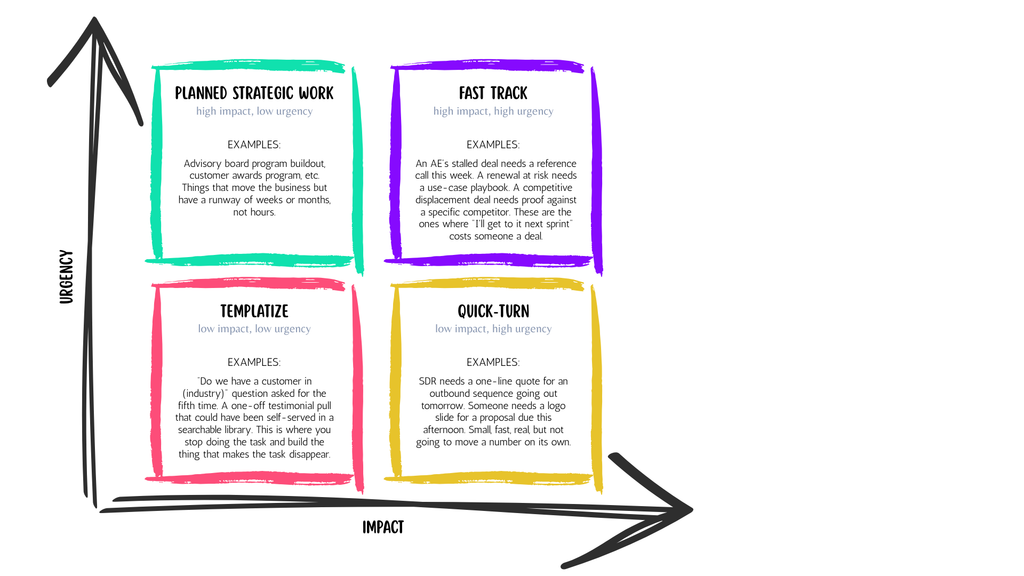
Look, most of us are running incredibly lean teams. You don’t get to say yes to every request, and trying to do so is its own kind of failure; this is coming from a recovering chronic people pleaser. When asks pop up down the road, take a quick peek at this handy dandy little decision matrix (patent pending) to help you gut check and have the honest “not this quarter” conversations. Doing so will build more trust than a rushed “yes” ever could.
The “case study machine” association won’t die in one meeting. You’ll say some version of “I’m more than case studies” in your fifth conversation with someone who sat through your first one. And hey, that just comes with the gig, right? But it’s our job to prove them wrong.
If you’re building out this kind of internal map for the first time, or trying to get a stakeholder off the case-study-only track, reply and tell me who you’re wrestling with. I’ll happily trade notes.
— Brayden