


This is a past send for The Outpost, a weekly newsletter filled with realtime insights and tactics for building more impactful customer marketing programs. To get The Outpost in your inbox every week, subscribe right here.
During one of the customer roundtables I participated in at Highline this year, someone said something that could’ve ground the whole conversation to a halt: “Verified, anonymous proof doesn’t actually do anything.”
Three or four other customers jumped in before the first person could finish the sentence. Yes it does! Here’s why.
That moment stuck with me because not 24 hours earlier, I’d had a chat with my good friend Cache Walker, and he’d broken down that exact question for me.
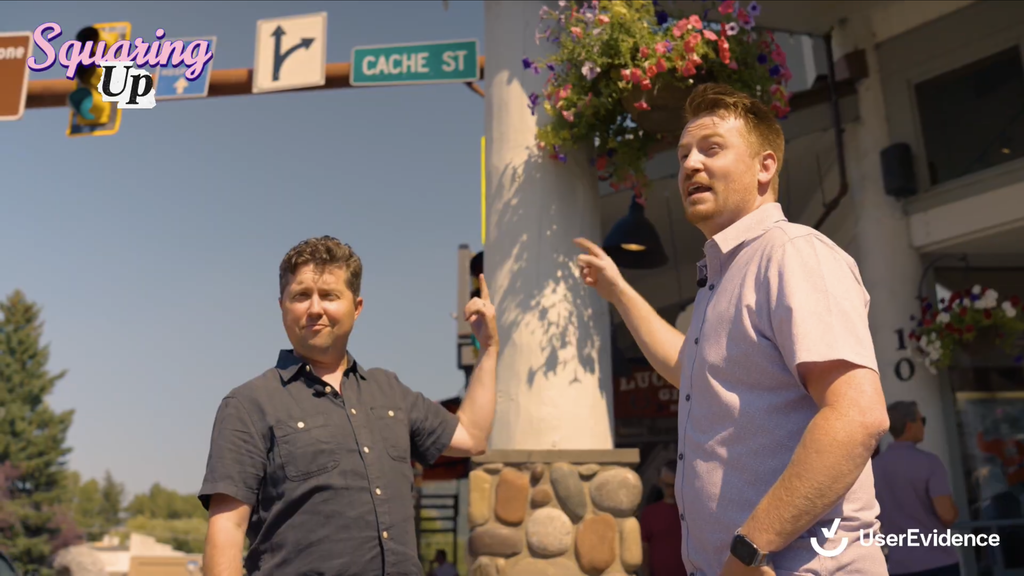
Ironically, the last time we’d sat down together like that was back in 2019, and he was the one interviewing me for my first bona fide customer advocacy role. Highline was the first time we’d seen each other in person since, so we caught up properly via a stagecoach ride through downtown Jackson and a walk down Cache Street.
(Yes, that’s really the street he’s named after. No, I did not know that until he told me.)
Seven years later, he’s still teaching me things. Here are my favorite nuggets from our conversation:
1. How he deflects almost all 1:1 reference requests
The appetite for sales references is insatiable. Reps have a job to do, they need something to grease the wheels, and they need it yesterday. Totally fair. But more often than not, the ask comes with a laundry list: e.g., the customer needs to be in the enterprise financial space, cater exclusively to lake-adjacent credit unions in landlocked states, have switched off your biggest competitor during a leap year, and have a CISO who’ll drop “game changer” at least thrice on a prospect call.
And, to put it plainly, most advocates don’t particularly enjoy jumping on those calls either.
Cache uses his team’s UserEvidence library to catch that ask before it even reaches a live customer. He handles it the same way he handles his kids: deflect first, and if they stay persistent, then we’ll see. Reps get pointed to self-serve proof first. If they come back with something specific and thoughtful, and the opportunity is far enough along to be real, that’s when he considers bringing in an advocate.
“I’m not saying I won’t put an advocate on the phone with somebody,“ Cache said. “I’m saying I really, really don’t like to. And I don’t think the advocate does either.”
More often than not, it never gets that far. “When you give them good quality content, you’ve got to teach your sellers that’s enough,” Cache told me. “In my experience, the trend over the last three to four years is that it really is enough. Like, $20 million deals.”
And when a call does happen, it’s a better one. The prospect has already seen the proof and shows up wanting to dig into something specific, so the advocate walks into a rich conversation that’s actually worth their time.
I feel like people talk about a reference library and a reference program like they’re the same thing. They’re not, and the fact that he’s built one to protect the other was pretty eye-opening to me.
2. Why he stopped asking for customers to go on the record
Cache and I both cut our teeth in cybersecurity, an industry notorious for the “customers just won’t go on the record” problem. They love the product just fine. They just don’t want their company to become a target. Respect – we totally get it.
So he leads with that when he asks for their story, telling them that their name doesn’t need to be on it, because the use case and technical details can speak for themselves. Verification on the back end then confirms it really came from, say, a CISO in a secured sector of the energy space.
Here’s the answer to the roundtable question. Without verification, buyers assume anonymous proof is marketing fluff (or that the customer got a discount for saying it). With it, prospects take it seriously. After all, they’d want the same anonymity if they were in that seat.
3. Where he always pushes back on leadership
Leadership almost always wants the grandiose story, where the customer rolled out everything, loved every feature, and saw 10x results. That story rarely exists, and Cache doesn’t wait around for it.
His advice is to capture all the pieces. Every buyer starts their evaluation somewhere different. Maybe it’s support, maybe it’s onboarding, maybe it’s one specific use case. And now that buyers are asking AI engines, their questions are more varied than ever.
So capture customers where they are with whatever they’re willing to give. That glowing review of your support team might not say much about the product, but someday a prospect who got burned by their last vendor is going to want exactly that proof.
4. The one thing he stopped doing with all of his case studies
Honesty moment: I have a love-hate relationship with full-length written case studies. In my past roles they’d go through so many rounds of marketing cleansing that what came out the other side was distilled, jargon-laden, marketing spewage. Cache keeps it close to what the customer actually said, which makes it powerful, defensible, and what people actually want to see. I particularly loved his Amazon reviews analogy having raised a dubious brow myself many times at a “perfect 5-star product” (these are definitely not bot reviews… sure).
Cache had way more to say than I could fit in one email, so hop on the stagecoach with us and catch the full convo in the latest episode of Squaring Up.