


This is a past send for The Outpost, a weekly newsletter filled with realtime insights and tactics for building more impactful customer marketing programs. To get The Outpost in your inbox every week, subscribe right here.
We just wrapped our annual census survey at UserEvidence. To keep with the Outpost theme (and stay true to my dad jokes) this was not my first rodeo. I’ve run these at several customer marketing seats I’ve held. But this one still managed to teach me something new. Actually, it re-taught me something old that I’d let myself forget. And spoiler alert…it wasn’t the kindest teacher.
Here’s the thing about census surveys: most everyone treats the send as the finish line. It’s not. It’s the midpoint. There are two moments that actually decide whether the whole thing was worth it, and most teams only plan for one of them:
Moment 1: everything that happens before you hit send.
Moment 2: everything that happens after the responses start rolling in.
At the risk of going overboard in my first send, I’ll opt to just peel back the layers of Moment 1 this week. Next week, we’ll dive into Moment 2.
Moment 1: everything that happens before you hit send.
In my experience, this is where the temptation to rush is strongest, because by the time you’re this deep into building a survey, you just want it out. You’ve gotta try to resist that. A few things I’ve learned to get right here (the hard way more than once):
Start with the end in mind, not the questions
Before you write a single question, get clear with your stakeholders on what gap(s) you’re actually trying to close. Is it a lack of proof for a specific product line? Time-to-value stats for sales? ROI for exec-level conversations? Once you know that, the questions basically write themselves.
Word your questions to surface the quote, not just the data
In that due diligence, sales flagged that they’d been fielding concerns about how long it would take a new customer to get real value from our platform. That’s valid right? No one wants to go to bat for budget and put in effort toward a platform launch if you won’t see any fruits from that labor for several quarters down the road.
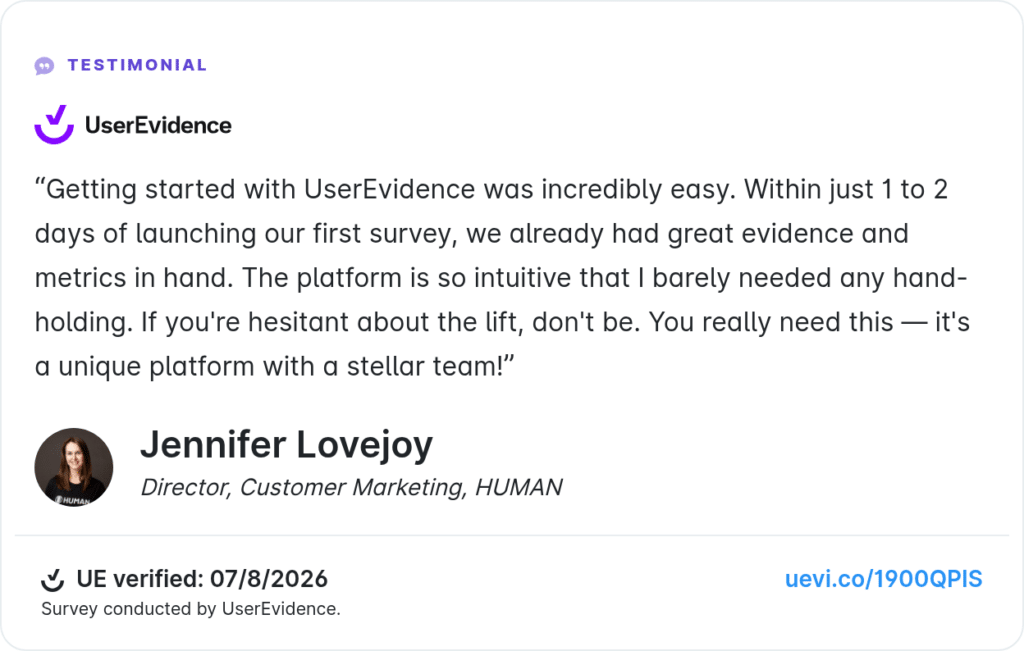
So instead of a generic satisfaction question, we asked something closer to: “Teams often worry that adopting a new platform will be a heavy lift. What was getting started with UserEvidence actually like, and how quickly did you see something useful come out of it?” That single question got us some of our best quotes from the entire survey. Specificity in the question gets you specificity in the answer. Here’s one of the absolutely golden quotes we got out of this question, thanks to the framing (and to Jennifer, for being the best):
Narrow your list before you widen your reach
It’s tempting to blast your entire customer base for a bigger sample size. I’d argue the opposite: send it to the people actually living in your product day-to-day, like the owners, the admins, the ones who can speak to it with authority and tie it all back to business outcomes. Two responses with actual teeth from the right people beat nineteen forgettable ones from the wrong list, every time. It’s a game of quality over quantity, and quantity has never once written a good case study.
Test it. Then test it again. Then get a second set of eyes on it. Then a third…hey, by the way, you should probably test it again
OK, you get the point. But this is the one I’ll admit I underestimated this time around; not the process itself (I ran multiple passes and got fresh eyes on it), but how much a shrinking launch window could undercut all of it anyway. Due to lots of life life-ing type of things (unexpected time off, travel, new job things) and a tight ship date, even doing it by the book wasn’t enough of a buffer.
Here’s an example:
We had title, company, and NPS mapped out in our planning doc from the start, and somehow they didn’t make it into the live survey. I didn’t catch it until after the first email went out, which meant a scramble to get it fixed before subsequent sends, plus more work down the road to rectify details I hadn’t captured in the initial wave. Fixable sure, but not fun.
A single read-through isn’t testing. Apparently neither are two. Testing is testing, retesting, and then having someone who didn’t build it try to break it. Bake in ample time to test. Your future self will be happy you did.
Next week, I’ll be digging into Moment 2: everything that happens after the responses start rolling in. But if you’re curious now, don’t wait for me–shoot me a reply. I genuinely love talking shop on this stuff, so consider that a genuine open invitation. And if you want a head start on your own, grab our 7 customer evidence survey templates (fewer scrambles guaranteed).